
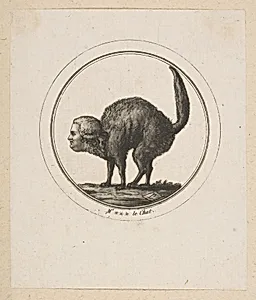
Caricature Showing the Comte de Provence as a Cat
18th century
Medium
Etching
Dimensions
sheet: 4 1/2 x 3 7/8 in. (11.5 x 9.8 cm)
Classification
Prints
Department
Drawings and Prints
Museum
Metropolitan Museum of Art, New York, NY
Credit
The Elisha Whittelsey Collection, The Elisha Whittelsey Fund, 1962
Accession Number
62.520.15
Rights
Public Domain
Tags
Art Historical Context
This small 18th-century etching, created by an anonymous French artist, offers a playful yet pointed example revolutionary-era satire. Measuring just over four inches tall, the print depicts the Comte de Provence—brother of Louis XVI and future King Louis XVIII—as a cat. Such imagery was typical of the period’s sharp political humor, using animal forms to comment on the character or actions of public figures. Caricatures like this one played a vital role during the French Revolution, circulating widely through affordable prints that reached audiences beyond elite circles. Etching, with its fine lines and quick production, proved ideal for timely commentary, allowing artists to respond rapidly to unfolding events. The work’s modest size suggests it was meant for personal collections or handheld viewing rather than public display. Now part of the Metropolitan Museum’s collection, the print reminds us how visual wit helped shape public opinion in a turbulent age. Its survival highlights the enduring power of caricature to capture the tensions between monarchy and emerging republican ideals.
About the Artist
Anonymous, French, 18th century · 1700–1800
The artist known as Anonymous, French, 18th century, represents a collective of unidentified talents active roughly between 1700 and 1800, a period of profound artistic evolution in France from the opulent Rococo to the austere dawn of Neoclassicism and Revolutionary fervor. Little is documented about their personal training or mentors, as their anonymity obscures individual biographies, though th...