
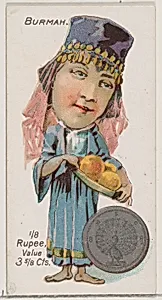
Caricatured Burmese figure, 1/8 Rupee, from the series Coins of All Nations (N72, variation 1) for Duke brand cigarettes
Medium
Commercial color lithograph
Dimensions
Sheet: 2 3/4 x 1 1/2 in. (7 x 3.8 cm)
Classification
Prints|Ephemera
Department
Drawings and Prints
Museum
Metropolitan Museum of Art, New York, NY
Credit
The Jefferson R. Burdick Collection, Gift of Jefferson R. Burdick
Accession Number
63.350.204.72.15
Rights
Public Domain
Tags
Art Historical Context
Step into the vibrant world of 19th-century advertising with this diminutive *Caricatured Burmese figure, 1/8 Rupee*, a commercial color lithograph from W. Duke, Sons &.'s *Coins of All Nations* (N72, variation1), produced in 1889. just 2¾ x 1½ inches, this tiny print was designed as a collectible trading card inserted into Duke brand cigarette packs, enticing smokers with educational glimpses of global currencies while promoting the product. Chromolithography, the medium here, revolutionized mass printing by layering vibrant colors through multiple stone plates, allowing for eye-catching reproductions affordable for everyday consumers. Duke's cards, part of a broader trend in tobacco ephemera, tapped into Victorian fascination with exoticism and empire, caricaturing a Burmese coin figure in a stylized, humorous manner that reflected Western colonial gazes on Asia. Today, housed in the Metropolitan Museum of Art's Drawings and Prints department as part of The Jefferson R. Burdick Collection, this ephemera highlights how commerce intertwined with culture, turning pocket change into portable art that fueled early collecting crazes. A window into Gilded Age marketing ingenuity!
About the Artist
W. Duke, Sons & Co. · 1870–1920
**W. Duke, Sons & Co.: Pioneers of Chromolithographic Trade Card Art** W. Duke, Sons & Co., an American tobacco manufacturer, emerged from the entrepreneurial vision of Washington Duke (1820–1905) and his sons in Durham, North Carolina. After the Civil War, Washington abandoned farming in 1874 to join his eldest son, Brodie L. Duke, in the burgeoning tobacco trade, establishing a factory that for...