
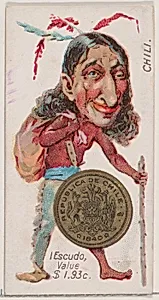
Caricatured Chilean figure, 1 Escudo, from the series Coins of All Nations (N72, variation 1) for Duke brand cigarettes
Medium
Commercial color lithograph
Dimensions
Sheet: 2 3/4 x 1 1/2 in. (7 x 3.8 cm)
Classification
Prints|Ephemera
Department
Drawings and Prints
Museum
Metropolitan Museum of Art, New York, NY
Credit
The Jefferson R. Burdick Collection, Gift of Jefferson R. Burdick
Accession Number
63.350.204.72.21
Rights
Public Domain
Tags
Art Historical Context
Step into the vibrant world of 19th-century advertising with this diminutive gem: *Caricatured Chilean figure 1 Escudo, from the series Coins of All Nations (N72, variation 1)*, produced by W. Duke Sons & Co. in 1889. This commercial color lithograph, measuring just 2 3/4 x 1 1/2 inches, captures a stylized, exaggerated depiction of a Chilean coin featuring a male figure, blending numismatic accuracy with playful caricature. As part of a popular series inserted into Duke cigarette packs, it invited smokers to collect and trade these tiny treasures, turning everyday tobacco into a gateway for global exploration. Chromolithography, the medium here, was a breakthrough technique of the era, allowing for vivid, multi-color prints produced inexpensively at scale—perfect for mass marketing. Duke, a leading American tobacco firm, pioneered such inserts to hook customers, fostering a collecting craze that echoed the era's fascination with world cultures and exotic currencies. The caricatured style reflects late Victorian stereotypes, infusing humor and intrigue into education about distant lands like Chile. Housed in the Metropolitan Museum of Art's Drawings and Prints department as part of The Jefferson R. Burdick Collection, this ephemera highlights how commerce shaped popular art. It reminds us that even humble cigarette cards carried cultural weight, bridging art, history, and consumer culture in Gilded Age America.
About the Artist
W. Duke, Sons & Co. · 1870–1920
**W. Duke, Sons & Co.: Pioneers of Chromolithographic Trade Card Art** W. Duke, Sons & Co., an American tobacco manufacturer, emerged from the entrepreneurial vision of Washington Duke (1820–1905) and his sons in Durham, North Carolina. After the Civil War, Washington abandoned farming in 1874 to join his eldest son, Brodie L. Duke, in the burgeoning tobacco trade, establishing a factory that for...