
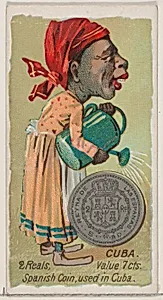
Caricatured Cuban, 2 Reals, from the series Coins of All Nations (N72, variation 2) for Duke brand cigarettes
Medium
Commercial color lithograph
Dimensions
Sheet: 2 3/4 x 1 1/2 in. (7 x 3.8 cm)
Classification
Prints|Ephemera
Department
Drawings and Prints
Museum
Metropolitan Museum of Art, New York, NY
Credit
The Jefferson R. Burdick Collection, Gift of Jefferson R. Burdick
Accession Number
63.350.204.72.28
Rights
Public Domain
Tags
Art Historical Context
In 1889, the American tobacco giant W. Duke, Sons & Co. issued this vibrant chromolithograph as part of their "Coins of All Nations" series (N72, variation 2), tucked into Duke brand cigarette packs as collectible inserts. Titled *Caricatured Cuban, 2 Reals*, the diminutive card (just 2¾ x 1½ inches) playfully depicts a Cuban coin featuring a woman, blending education with exotic allure to entice smokers and boost sales during the Gilded Age's advertising boom. Chromolithography, a pioneering color printing technique, allowed mass production of these eye-catching ephemera, transforming everyday coins into whimsical caricatures. This reflects late-19th-century consumer culture, where tobacco companies popularized global trivia—here evoking Cuba's colonial coinage amid U.S. economic interests in the Caribbean. Today, preserved in The Metropolitan Museum of Art's Jefferson R. Burdick Collection, it highlights ephemera's artistic value: a snapshot of imperialism, gender imagery, and collecting mania that shaped modern trading cards. A tiny portal to history's hustles!
About the Artist
W. Duke, Sons & Co. · 1870–1920
**W. Duke, Sons & Co.: Pioneers of Chromolithographic Trade Card Art** W. Duke, Sons & Co., an American tobacco manufacturer, emerged from the entrepreneurial vision of Washington Duke (1820–1905) and his sons in Durham, North Carolina. After the Civil War, Washington abandoned farming in 1874 to join his eldest son, Brodie L. Duke, in the burgeoning tobacco trade, establishing a factory that for...