
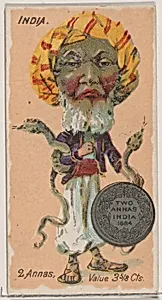
Caricatured Indian, 2 Annas, from the series Coins of All Nations (N72, variation 2) for Duke brand cigarettes
Medium
Commercial color lithograph
Dimensions
Sheet: 2 3/4 x 1 1/2 in. (7 x 3.8 cm)
Classification
Prints|Ephemera
Department
Drawings and Prints
Museum
Metropolitan Museum of Art, New York, NY
Credit
The Jefferson R. Burdick Collection, Gift of Jefferson R. Burdick
Accession Number
63.350.204.72.50
Rights
Public Domain
Tags
Art Historical Context
In the late 19th century, tobacco companies like W., Sons & Co. revolutionized advertising with collectible insert cards tucked into cigarette packs. This vibrant *Caricatured Indian,2 Annas*, from the 1889 *Coins of All Nations* (N72, variation2), exemplifies that clever marketing. Measuring just 2¾ x 1½ inches, this commercial color lithograph depicts a stylized figure representing British India's 2-anna coin—equal to one-sixteenth of a rupee—complete with exotic motifs like snakes, blending education on global currencies with playful caricature to entice collectors and boost Duke brand sales. Chromolithography, the era's cutting-edge technique for mass-producing vivid, multi-color prints from stone plates, allowed affordable yet eye-catching ephemera like this card. Produced amid the Gilded Age's boom in consumer culture, it reflects how everyday objects became gateways to armchair travel, introducing Americans to distant lands through simplified, often stereotypical imagery of "exotic" subjects. Today, housed in the Metropolitan Museum of Art's Jefferson R. Burdick Collection, this tiny print offers a window into advertising history and the birth of trading card obsessions. Its classification as ephemera underscores the artistry in the disposable, reminding us how commerce shaped popular visual culture.
About the Artist
W. Duke, Sons & Co. · 1870–1920
**W. Duke, Sons & Co.: Pioneers of Chromolithographic Trade Card Art** W. Duke, Sons & Co., an American tobacco manufacturer, emerged from the entrepreneurial vision of Washington Duke (1820–1905) and his sons in Durham, North Carolina. After the Civil War, Washington abandoned farming in 1874 to join his eldest son, Brodie L. Duke, in the burgeoning tobacco trade, establishing a factory that for...