
3344
1829
Medium
lithography
Dimensions
265; 358
Rights
Public Domain
About this artwork
lithografie
Art Historical Context
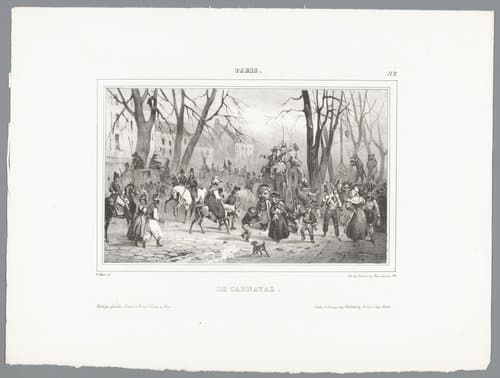
**3344 by Victor Adam (1829 Step into the world of early19th-century French printmaking with *3344*, a captivating lithography created by Victor Adam in1829. Measuring 265 mm high by 358 mm wide, this modestly scaled work exemplifies the artist's skill in translating fluid drawings onto stone, a technique that was revolutionizing art reproduction at the time. Adam (1801–1865), a versatile Parisian artist, was renowned for his lively depictions of urban life, theater scenes, and military motifs during the Romantic era, bridging painting and graphic arts with remarkable dexterity. Lithography, or "lithografie" as noted in period catalogs, allowed Adam to draw directly on limestone with greasy crayon, harnessing the medium's chemical properties for crisp, tonal prints. Invented just decades earlier, it democratized high-quality imagery, making art accessible beyond elite canvases. In 1829—amid France's Bourbon Restoration and rising revolutionary fervor—this technique fueled a boom in affordable illustrations, capturing the pulse of society. Though specifics of *3344*'s subject remain elusive, its creation marks a pivotal moment in lithography's golden age, showcasing Adam's contribution to a vibrant print culture that influenced illustrators for generations. A window into Romantic Paris, it invites us to appreciate the artistry of everyday innovation. (198 words)
About the Artist
Victor Adam · 1801–1866
Victor Adam was born in Paris in 1801 and built a prolific and commercially successful career as one of the leading lithographers and illustrators of nineteenth-century France. He received a conventional academic training in painting, but it was the new medium of lithography — still in its first decades of widespread use when Adam came of age — that provided the ideal vehicle for his gifts: a faci...