
Carpet Fragment
Unknown Artist
probably 18th century
Medium
Wool (warp, weft and pile); single-warp (Spanish) knotted pile
Dimensions
L. 22 in. (55.9 cm) W. 28 in. (71.1 cm)
Classification
Textiles-Rugs
Department
Islamic Art
Museum
Metropolitan Museum of Art, New York, NY
Credit
Gift of Joseph V. McMullan, 1957
Accession Number
57.150.5
Rights
Public Domain
Art Historical Context
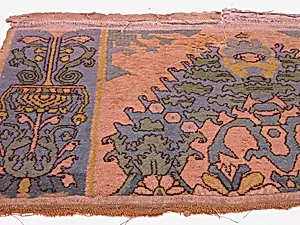
This exquisite carpet fragment, likely woven in the 18th century, offers a tantalizing glimpse into the rich tradition of Islamic textile artistry. Crafted from wool for its warp, weft, and lush pile, it employs the single-warp (Spanish)otted pile technique—a distinctive asymmetrical knot that allows for dense, intricate patterns and exceptional durability. Measuring 22 by 28 inches, this partial rug showcases the meticulous craftsmanship of anonymous weavers, whose work adorned homes, mosques, and palaces across the Islamic world. The Spanish knot, with roots in medieval Iberian weaving under Islamic influence, highlights a fusion of cultural techniques that persisted into later centuries. Such carpets were prized for their symbolic motifs—often floral, geometric, or arabesque designs evoking paradise gardens—and their role in daily life and trade. As a surviving fragment, it speaks to the fragility of these treasures, preserved through generations. Generously gifted to The Metropolitan Museum of Art in 1957 by Joseph V. McMullan, this piece invites visitors to appreciate the artistry of Islamic rugs, where every knot tells a story of skill, faith, and cultural exchange.