
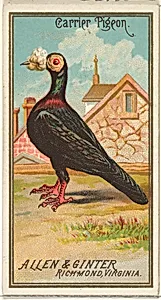
Carrier Pigeon, from the Birds of America series (N4) for Allen & Ginter Cigarettes Brands
1888
Medium
Commercial color lithograph
Dimensions
Sheet: 2 3/4 x 1 1/2 in. (7 x 3.8 cm)
Classification
Prints|Ephemera
Department
Drawings and Prints
Museum
Metropolitan Museum of Art, New York, NY
Credit
The Jefferson R. Burdick Collection, Gift of Jefferson R. Burdick
Accession Number
63.350.201.4.34
Rights
Public Domain
Tags
Art Historical Context
Step into the vibrant world of 19th-century advertising with *Carrier Pigeon* from Allen & Ginter's *s of America* seriesN4), a delightful 1888 commercial color lithograph. Produced by the pioneering tobacco firm Allen & G, this tiny card (just 2 3/4 x 1 1/2 inches) was tucked into cigarette packs as a collectible incentive, sparking a craze for trading cards among enthusiasts. Part of a larger set celebrating American birds, it captures the noble carrier pigeon—a bird historically vital for long-distance messaging before telegraphs and phones dominated communication. The artwork showcases chromolithography, a revolutionary printing technique that allowed mass production of vivid, multi-colored images from stone plates, making fine art accessible to everyday consumers. Allen & Ginter's cards blended education with promotion, drawing inspiration from natural history illustrations like John James Audubon's famous *Birds of America*, but in a pocket-sized, ephemeral format classified as prints and ephemera. Today, this gem resides in The Metropolitan Museum of Art's Jefferson R. Burdick Collection, a treasure trove of American card history gifted by the avid collector himself. It reminds us how commerce fueled popular culture, turning a simple pigeon into a symbol of innovation and nostalgia.
About the Artist
Allen & Ginter
Allen & Ginter, the pioneering American tobacco firm based in Richmond, Virginia, emerged around 1880 from the partnership of John F. Allen and Lewis Ginter, evolving from Allen's earlier John F. Allen & Company. Allen retired in 1882, succeeded by John Pope, yet the brand endured under Ginter's leadership, employing over 1,100 workers—mostly women—for hand-rolled cigarettes by 1886. Ginter, a Dut...