
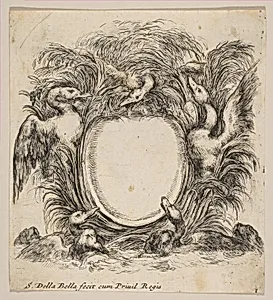
Cartouche Framed by Ducks and Weeds
Medium
Etching; first state
Dimensions
Sheet: 4 3/16 × 3 13/16 in. (10.7 × 9.7 cm)
Classification
Prints
Department
Drawings and Prints
Museum
Metropolitan Museum of Art, New York, NY
Credit
Bequest of Grace M. Pugh, 1985
Accession Number
1986.1180.651
Rights
Public Domain
Tags
Art Historical Context
### Cartouche Framed by Ducks andeds Created in 1647 by the Italian etcher Stefano della Bella, enchanting print captures the Baroque era's delight in ornate decoration. Della Bella, renowned for his intricate line work and whimsical motifs during his time in Florence and, produced this etching in its rare first state—meaning it's the unaltered proof before any revisions, prized by collectors for its purity. Measuring just 4 3/16 × 3 13/16 inches, the small sheet was ideal for albums, books, or furniture embellishment, published by La Veuve F. Langlois, a notable Parisian print dealer. At its heart is a decorative cartouche—an elaborate, scroll-like frame often used for coats of arms or inscriptions—playfully enclosed by lively ducks amid flowing weeds. Della Bella's etching technique shines here: fine, fluid lines etched into a metal plate with acid create textured feathers, rippling water, and sinuous foliage, evoking nature's abundance. This reflects 17th-century ornamental print culture, where such designs blended naturalism with fantasy for Europe's elite. Housed in the Metropolitan Museum of Art's Drawings and Prints department (Bequest of Grace M. Pugh, 1985), it exemplifies how prints democratized artistry, turning everyday objects into visual treasures. A charming glimpse into Baroque whimsy! (198 words)
About the Artist
Stefano della Bella|La Veuve F. Langlois · 1610–1664
Stefano della Bella (1610-1664) was one of the most prolific and versatile printmakers of the Italian Baroque period, leaving behind 1,052 prints and several thousand drawings that captured the vivid essence of 17th-century European life. Born in Florence on May 18, 1610, to a family of artists, he trained initially as a goldsmith before studying painting under Cesare Dandini and etching under Rem...