
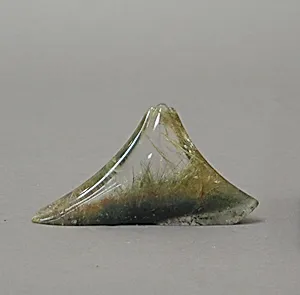
Carving in Form of Fujiama
Unknown Artist
18th century
Medium
Rock crystal; green stained ivory stand
Dimensions
H. 2 5/8 in. (6.7 cm); W. 4 7/8 in. (12.4 cm)
Classification
Hardstone
Culture
China
Department
Asian Art
Museum
Metropolitan Museum of Art, New York, NY
Credit
Gift of Heber R. Bishop, 1902
Accession Number
02.18.850a, b
Rights
Public Domain
Art Historical Context
This exquisite *Carving in Form ofiama*, from 18th-century China, captures the majestic silhouette of Mount Fuji—a sacred Japanese peak revered for its beauty—in translucent rock crystal. Perched on a green-stained ivory stand, this pocket-sized gem measures just 2⅝ inches high and 4⅞ inches wide, making it a perfect example of portable luxury for scholars or collectors. The unknown artist's skill shines through the crystal's clarity, which allows light to dance within, evoking the mountain's misty allure. Rock crystal, a form of quartz, was a prized hardstone in Qing dynasty China, where carvers honed techniques passed down for centuries to transform unyielding material into intricate sculptures. Unlike softer jade, crystal demanded exceptional precision, highlighting the artisan's mastery. This piece reflects the era's fascination with natural wonders, blending Chinese carving prowess with admiration for Japanese iconography amid growing cultural exchanges via trade. Today, housed in the Metropolitan Museum of Art's Asian Art department as a gift from Heber R. Bishop in 1902, it invites visitors to ponder the bridges between East Asian cultures. Imagine holding this luminous treasure, a testament to artistry that transcends borders.