
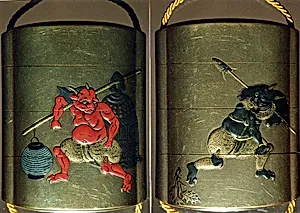
Case (Inrō) with Design of an Oni (Demon) Carrying a Temple Bell and Paper Lantern over His Shoulder (obverse); Oni Carrying Fish Head Stuck on a Pole and Holly Branch (reverse)
Unknown Artist
18th–19th century
Medium
Lacquer, kinji, gold, red, silver and black hiramakie, takamakie; Interior: silver lacquer and fundame
Dimensions
H. 2 9/16 in. (6.5 cm); W. 1 15/16 in. (5 cm); D. 11/16 in. (1.7 cm)
Classification
Inrō
Culture
Japan
Department
Asian Art
Museum
Metropolitan Museum of Art, New York, NY
Credit
Bequest of Stephen Whitney Phoenix, 1881
Accession Number
81.1.311
Rights
Public Domain
Tags
Art Historical Context
This exquisite inrō, or small lacquer case, dates to Japan’s Edo period in the 18th–19th century, when such portable containers were essential accessories for men. Worn suspended from the sash, inrō held medicines, seals, or other small items and reflected the wearer’s refined taste. The unknown artist has transformed this functional object into a miniature narrative scene, depicting playful oni (demons) on both sides—one shouldering a temple bell and paper lantern, the other carrying a fish head on a pole and a holly branch. The case showcases sophisticated lacquer techniques, including hiramakie (flat gold sprinkling) and takamakie (raised relief), applied over a kinji ground with accents of red, silver, and black. These methods create luminous depth and texture within a remarkably compact space measuring just over two and a half inches tall. The interior’s silver lacquer and fundame finish further demonstrate the meticulous attention given to every surface. As a work of Asian art now in the Metropolitan Museum’s collection, this inrō highlights the blend of utility, folklore, and technical mastery that defined Japanese decorative arts of the period. Its lively demon motifs and references to musical instruments and seasonal elements continue to delight viewers with their imaginative storytelling.