
Case (Inrō) with Design of Chinese Woman at Court Feeding a Parrot
Unknown Artist
late 18th century
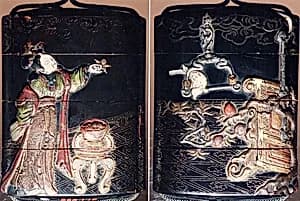
Medium
Roiro (waxen) lacquer decorated with incised gold and metal, ceramic, ivory, and coral inlay
Dimensions
H. 2 13/16 in. (7.2 cm); W. 2 1/16 in. (5.3 cm); D. 7/8 in. (2.3 cm)
Classification
Inrō
Culture & Period
Japan · Edo period (1615–1868)
Department
Asian Art
Museum
Metropolitan Museum of Art, New York, NY
Credit
Edward C. Moore Collection, Bequest of Edward C. Moore, 1891
Accession Number
91.1.696
Rights
Public Domain
Tags
Art Historical Context
This exquisite *Inrō*, or lacquered case, from late 18th-century Japan during the Edo period (1615–1868), depicts a graceful Chinese woman at court feeding a vibrant parrot. Measuring just under 3 inches tall, this pocket-sized accessory was designed for men to carry medicines, seals, or tobacco, suspended from the waist by a cord and secured with an ivory *netsuke* and *ojime* bead (though not included here). Its diminutive scale belies the opulent craftsmanship, showcasing the era's mastery of luxury goods amid Japan's urban prosperity. Crafted in *roiro* (waxen black) lacquer—a highly polished, mirror-like finish—the surface is intricately decorated with incised gold and metal details, enhanced by ceramic, ivory, and coral inlays. These techniques highlight the technical virtuosity of anonymous Edo artisans, who elevated everyday objects into wearable art. The motif of a woman and parrot draws on popular Chinese-inspired imagery, blending exotic elegance with Japanese refinement. Housed in the Metropolitan Museum of Art's Asian Art Department as part of the Edward C. Moore Collection (1891), this *inrō* offers a window into Edo society's fascination with beauty in the mundane, where such cases served as subtle status symbols for samurai and merchants alike. A charming testament to cross-cultural whimsy!