
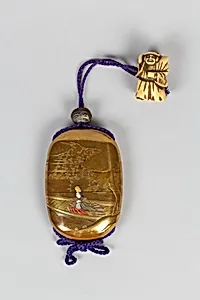
Case (Inrō) with Design of Court Lady in Boat with Drum (obverse); Geese Taking Flight (reverse)
19th century
Medium
Lacquer, kinji, gold hiramakie, kirigane, nashiji, metal, ivory, raden inlay; Interior: nashiji and fudame
Dimensions
3 7/16 x 2 3/8 x 7/8 in. (8.7 x 6.1 x 2.2 cm)
Classification
Inrō
Culture & Period
Japan · Edo period (1615–1868)
Department
Asian Art
Museum
Metropolitan Museum of Art, New York, NY
Credit
H. O. Havemeyer Collection, Bequest of Mrs. H. O. Havemeyer, 1929
Accession Number
29.100.863
Rights
Public Domain
Tags
Art Historical Context
This exquisite *inrō*, a compact lacquered case from 19th-century Japan, crafted by Shibayama Shai of the renowned Kajikawa School during the Edo period (161–1868). *Inrō* were essential accessories for Japanese men, suspended from the belt via cords, netsuke toggles, and ojime to carry medicines, seals, or tobacco. Worn by samurai and merchants alike, they epitomized refined craftsmanship and personal style in a time of urban prosperity and cultural flourishing. The obverse features a graceful court lady in a boat, playfully holding a drum amid misty mountains and rippling waters, while the reverse depicts geese taking flight—evoking poetic themes of transience and nature's beauty drawn from classical Japanese literature. Shibayama's mastery shines in the layered techniques: kinji ground for a golden sheen, gold hiramakie (flat sprinkled gold lacquer), kirigane (cut gold foil), shimmering nashiji (pear-skin gold flecks), raden (mother-of-pearl inlay), ivory, and metal accents. The interior's nashiji and fudame (coral-like lacquer) add luxurious depth. A highlight of the Metropolitan Museum of Art's H. O. Havemeyer Collection, this 3⅞-inch treasure showcases the Kajikawa School's pinnacle of lacquer innovation, blending functionality with artistry in Edo Japan's golden age of decorative arts.
About the Artist
Shibayama Shokasai|Kajikawa School (Japanese| ) · | – |
Japanese|