
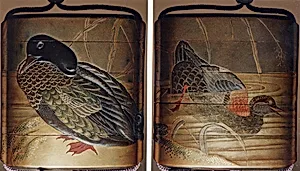
Case (Inrō) with Design of Duck Standing on Shore beside Reeds (obverse); Duck Diving into Water (reverse)
Unknown Artist
19th century
Medium
Lacquer, kinji, silver and coloured hiramakie, takamakie; Interior: nashiji and fundame
Dimensions
2 7/8 x 2 11/16 x 7/8 in. (7.3 x 6.8 x 2.2 cm)
Classification
Inrō
Culture
Japan
Department
Asian Art
Museum
Metropolitan Museum of Art, New York, NY
Credit
The Howard Mansfield Collection, Purchase, Rogers Fund, 1936
Accession Number
36.100.238
Rights
Public Domain
Tags
Art Historical Context
This exquisite 19th-century Japaneseinrō*—a small, lacquered case worn suspended from the belt via a cord and netsuke toggle—serves as both a practical accessory and a canvas for artistry. Measuring just under 3 inches tall, it features a duck poised gracefully on a reedy shore on the ob side, while the reverse depicts one diving into rippling water. Ducks in Japanese art often evoke themes of harmony, fidelity, and the fleeting beauty of nature, making this design a poetic nod to seasonal life along waterways. Crafted with masterful lacquer techniques, the exterior boasts a kinji (gold) ground enhanced by silver and colored *hiramakie* (flat sprinkled gold/silver) and *takamakie* (raised sprinkled motifs), creating textured depth and shimmering realism. The interior gleams with *nashiji* (pearlescent gold flecks) and *fundame* (solid gold/silver base), showcasing the Edo-period legacy of *urushi* lacquerwork, prized for its durability and luminosity despite the humid climate. Part of The Howard Mansfield Collection at The Metropolitan Museum of Art, this *inrō* highlights Japan's *inrō* culture, popular among samurai and merchants from the 17th to 19th centuries for carrying medicines, seals, or tobacco. It exemplifies the pinnacle of anonymous artisan skill, blending utility with breathtaking aesthetics for everyday elegance.