
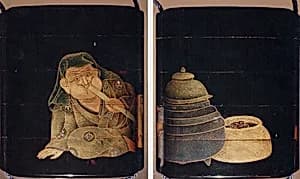
Case (Inrō) with Design of Man Blowing on a Brazier to Make Tea
Unknown Artist
18th–19th century
Medium
Lacquer, roiro, gold and coloured togidashi; Interior: nashiji and fundame; Netsuke: mouse; Ojime: floral bead
Dimensions
a) H. 2 15/16 in. (7.5 cm); W. 2 9/16 in. (6.5 cm) b) Gr. Diam. 1 1/2 in. (1.1 cm) c) L. 7/8 in. (2.2 cm)
Classification
Inrō
Culture & Period
Japan · Meiji period (1868–1912)
Department
Asian Art
Museum
Metropolitan Museum of Art, New York, NY
Credit
Bequest of Hope Skillman Schary, 1981
Accession Number
1982.244.15a–c
Rights
Public Domain
Tags
Art Historical Context
This exquisite *inrō*, a compact lacquer case from 18th–19th Japan (spanning late Edo to early Meiji period), served as a stylish accessory for men wearing traditional kimono. Suspended from the waist by a cord, it held small essentials like medicines or seals, secured by a carved netsuke—here, a charming mouse—and a floral ojime bead. The design a man intently blowing on a brazier heat water for tea, capturing a moment of everyday ritual tied to Japan's revered tea culture, from casual enjoyment to the formal *chanoyu* ceremony. Crafted with masterful lacquer techniques, the exterior features glossy *roiro* (mirror-black lacquer) adorned with gold and colored *togidashi*—designs subtly burnished through layers for a luminous effect. The interior gleams with *nashiji* (pearlescent gold flecks resembling nashi pear skin) and *fundame* (smooth gold base), showcasing the intricate, labor-intensive *urushi* lacquer tradition refined over centuries. At just 7.5 cm tall, its diminutive scale belies the artisan's precision. In the Metropolitan Museum of Art's Asian Art collection (Bequest of Hope Skillman Schary, 1981), this inrō reflects Meiji-era (1868–1912) craftsmanship amid Japan's modernization, blending utilitarian function with poetic scenes of daily life. It invites us to appreciate how such objects turned personal necessities into wearable art.