
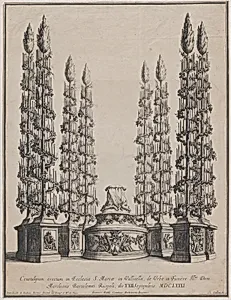
Catafalque for Marchese Bartolomeo Ruspoli, S. Maria in Vallicella, Rome, September 21, 1681
Medium
Etching
Dimensions
Sheet (Trimmed): 16 3/4 × 12 13/16 in. (42.5 × 32.6 cm)
Classification
Prints|Prints-Fete|Ornament & Architecture
Department
Drawings and Prints
Museum
Metropolitan Museum of Art, New York, NY
Credit
The Elisha Whittelsey Collection, The Elisha Whittelsey Fund, 1965
Accession Number
65.546.8
Rights
Public Domain
Tags
Art Historical Context
This intricate etching captures the grandeur of a Baroque catafalque—a temporary funerary monument—erected for Marchese Bartolomeopoli at S. Maria in Vallicella (Chiesa Nuova) in Rome September 21, 1. Created by the skilled Roman printmaker and publisher Giovanni Giacomo Rossi, in collaboration with architect Giovanni Battista Contini and possibly Johannes Collin, it documents a lavish ceremonial structure honoring a prominent nobleman from the influential Ruspoli family. design features symbolic motifs like skulls (evoking memento mori ornate leaves, and the family coat of arms, blending heraldry with dramatic ornamentation typical of 17th-century Roman elite funerals. As an etching on a trimmed sheet measuring 16¾ × 12⅞ inches, the print excels in rendering fine architectural details and intricate patterns through acid-etched lines on a metal plate, a technique that allowed precise reproduction of ephemeral events. Classified under prints of fêtes, ornament, and architecture, it preserves the theatrical splendor of Baroque funerary rites, where such monuments rivaled permanent sculptures in scale and symbolism. Housed in the Metropolitan Museum of Art's Elisha Whittelsey Collection, this work offers a window into Rome's vibrant print culture, which disseminated designs for grand occasions across Europe. Visitors will appreciate its blend of mourning and magnificence, a testament to the era's fusion of piety, power, and artistry.