
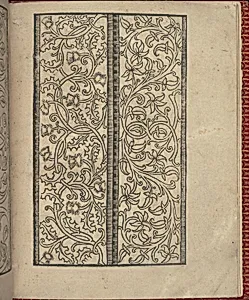
Ce est ung tractat de la noble art de leguille ascavoir ouvraiges de spaigne... page 23 (recto)
after 1527
Medium
Woodcut
Dimensions
Overall: 6 7/8 x 5 11/16 in. (17.5 x 14.5 cm)
Classification
Books|(not assigned)|Ornament & Architecture
Department
Drawings and Prints
Museum
Metropolitan Museum of Art, New York, NY
Credit
Gift of Mary M. Greenwood, in memory of Eliza Rudd Greenwood, 1953
Accession Number
53.566.3(45)
Rights
Public Domain
Tags
Art Historical Context
This woodcut appears on page 23 (recto) of a rare early pattern book titled *Ce est ung tractat de la noble art de leguille ascavoir ouvraiges de spaigne...*, printed after 1527 by Willem Vosterman. Produced in Antwerp, the volume served as a practical guide to embroidery, offering designs inspired by Spanish needlework traditions that were highly prized across Europe at the time. The page features delicate floral and vine motifs, intended as templates for stitching onto textiles. As a woodcut, the image reflects the growing use of printmaking in the sixteenth century to spread ornamental patterns beyond the workshops of professional embroiderers. Vosterman’s press helped democratize access to fashionable designs, allowing amateur and professional needleworkers alike to replicate intricate floral scrolls in their own work. Such books played a quiet but important role in shaping domestic and courtly aesthetics during the Renaissance. Today, this leaf in the Metropolitan Museum’s collection preserves both a functional design and a snapshot of how printed ornament traveled between cultures and crafts. Its compact size—roughly 6 7/8 by 5 11/16 inches—made it easy to consult at the embroidery frame, underscoring the intimate link between printed page and stitched textile.
About the Artist
Willem Vosterman
Willem Vosterman was a Netherlandish engraver and printmaker who worked within the rich tradition of graphic art that flourished in the Low Countries during the sixteenth and seventeenth centuries. Precise details of his birth, death, and training are not firmly established in the historical record, but his surviving prints reflect the skilled craftsmanship and commercial acuity that characterized...