
Ceiling painting from the palace of Amenhotep III
Unknown Artist
ca. 1390–1352 B.C.
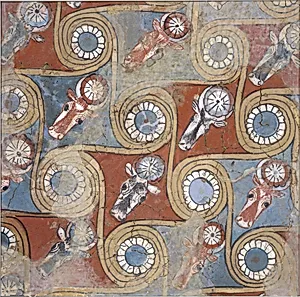
Medium
Dried Mud, mud plaster, paint, gesso
Dimensions
h. 140 cm (55 1/8 in); w. 140 cm (55 1/8 in)
Classification
Ceiling painting, palace of Amenhotep III
Period
New Kingdom
Department
Egyptian Art
Museum
Metropolitan Museum of Art, New York, NY
Credit
Rogers Fund, 1911
Accession Number
11.215.451
Rights
Public Domain
Tags
Art Historical Context
This vibrant ceiling painting fragment hails from the grand palace of Amenhotep III one of Egypt's most prosperous pharaohs during the New Kingdom's 18th Dynasty (. 1390–1352 B.C.). Amenhotep III's reign marked a golden age of wealth, diplomacy, and monumental building, with his Malkata palace complex serving as a lavish residence on the west bank of Thebes. Such ceiling decorations adorned elite interiors, transforming vast spaces into celestial or earthly paradises that reflected the pharaoh's divine power and harmony with nature. Crafted from dried mud, mud plaster, paint, and gesso—a preparatory layer for smooth pigment adhesion—this 140 x 140 cm square exemplifies New Kingdom techniques. Artists applied vivid colors to mud-based surfaces, a practical choice for Egypt's dry climate that allowed intricate designs to endure. The central motif of an ox evokes fertility, strength, and abundance, symbols central to Egyptian cosmology and royal ideology, where animals bridged the mundane and divine realms. Acquired through the Rogers Fund in 1911, this rare survivor offers a glimpse into the opulent daily life of ancient royalty, preserved at The Metropolitan Museum of Art's Egyptian Art department. It reminds us how art elevated palaces into symbolic universes.