
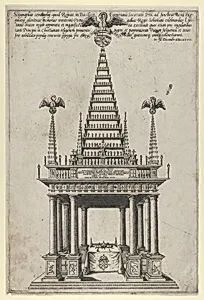
Cenotaph for Sebastian I, King of Portugal, Basilica Farnesina, Rome, December 3, 1578
1578
Medium
Etching
Dimensions
Sheet (Trimmed): 14 15/16 in. × 10 in. (38 × 25.4 cm)
Classification
Prints|Prints-Fete|Ornament & Architecture
Department
Drawings and Prints
Museum
Metropolitan Museum of Art, New York, NY
Credit
The Elisha Whittelsey Collection, The Elisha Whittelsey Fund, 1967
Accession Number
67.542.21
Rights
Public Domain
Tags
Art Historical Context
In the opulent Basilica Farnesina in Rome on December 3, 1578, a magnificent cenotaph—an empty tomb honoring the absent body—was erected for Sebastian I, the young King of Portugal. This etching by Mario Cartaro captures the grandeur of the event, mere months after Sebastian's presumed death at the Battle of Alcáceribir in Morocco. His body was never recovered, fueling legends of his survival and prompting elaborate memorials across Europe. The print vividly depicts towering monuments adorned with coats of arms and symbolic birds, evoking the pomp of Renaissance funerals and Portugal's imperial ambitions. Cartaro, a skilled Italian etcher active in Rome, masterfully employs the etching technique—using acid to bite intricate lines into a metal plate—to reproduce architectural flourishes and ornamental details with remarkable precision. This allowed for multiple impressions, disseminating the spectacle to a wider audience beyond the elite attendees. Classified among prints of fêtes, ornaments, and architecture, it exemplifies 16th-century printmaking's role in preserving ephemeral ceremonies. Today, housed in the Metropolitan Museum of Art's Drawings and Prints department, this work (14 15/16 × 10 in.) offers a window into the cultural interplay between Portugal and papal Rome, blending mourning with artistic virtuosity.