
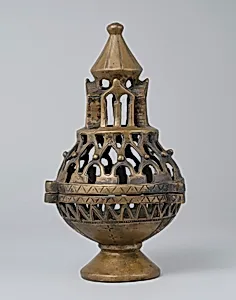
Censer
Unknown Artist
13th century
Medium
Copper alloy
Dimensions
Overall: 9 x 3 5/8 in. (22.9 x 9.2 cm)
Classification
Metalwork-Copper alloy
Culture
German
Department
Medieval Art
Museum
Metropolitan Museum of Art, New York, NY
Credit
Rogers Fund, 1909
Accession Number
09.152.4
Rights
Public Domain
Art Historical Context
This exquisite 13th-century censer, crafted from copper alloy by an unknown German artisan, stands as a testament to the refined metalworking traditions of medieval Europe. Measuring just 9 x 3⅝ inches, its compact form belies its ritual importance, designed to hold and swing burning incense during religious ceremonies. Housed in the Metropolitan Museum of Art's Medieval department (acquired via the Rogers Fund in 1909), it the era's ecclesiastical metalwork, where durable alloys like copper were favored for their malleability and resistance to heat. In the vibrant Gothic period of 13th-century Germany, censers played a central role in Catholic liturgy, their fragrant smoke symbolizing prayers ascending to heaven and purifying sacred spaces. This object would have swung from chains (though not preserved here) in grand cathedrals, filling the air with myrrh or frankincense amid chants and candlelight. German metalworkers excelled in lost-wax casting and chasing techniques, likely employed here to create intricate perforations for smoke dispersal and a balanced, ergonomic shape. Today, this censer invites us to ponder the sensory world of medieval devotion—where sight, scent, and sound intertwined in worship—highlighting the artistry that made the divine tangible.