
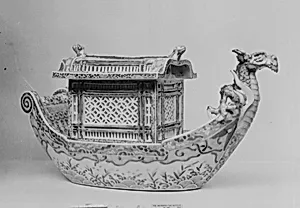
Censer in form of a Pleasure Boat
Unknown Artist
1830
Medium
White porcelain decorated in blue under the glaze
Dimensions
H. 8 1/2 in. (21.6 cm); w. 6 3/4 in. (17.1 cm); L. 16 in. (40.6 cm)
Classification
Ceramics
Culture & Period
Japan · Edo period (1615–1868)
Department
Asian Art
Museum
Metropolitan Museum of Art, New York, NY
Credit
Gift of Mrs. V. Everit Macy, 1923
Accession Number
23.225.327a, b
Rights
Public Domain
Tags
Art Historical Context
Nestled in the Metropolitan Museum of Art's Asian Art collection, this enchanting *Censer in the Form of a Pleasure Boat (1830) hails from Japan's Edo period (16151868), a time of relative peace and cultural flourishing. Crafted by an unknown artist, this whimsical ceramic vessel measures 16 inches long, evoking the leisurely river outings enjoyed by the era's affluent merchants and samurai. Shaped like a traditional Japanese pleasure boat, it served as an incense burner, releasing fragrant smoke through subtle openings, blending utility with playful fantasy. The censer's white porcelain body, adorned with blue underglaze decoration, exemplifies Japan's mastery of this technique, inspired by Chinese blue-and-white wares but refined with local elegance. Fired at high temperatures, the cobalt-blue motifs—likely featuring dragons, symbols of power and good fortune—remain vivid beneath the glassy glaze, resistant to fading over time. Such censers were prized in tea ceremonies, Buddhist rituals, and elite homes, where incense purified the air and evoked serene atmospheres. A generous gift from Mrs. V. Everit Macy in 1923, this piece captures the Edo period's delight in decorative arts, transforming everyday objects into miniature worlds of imagination. Visitors can almost hear the gentle lap of water and catch a whiff of sandalwood lingering in the air.