
Ceramic Architectural Decoration
13th century
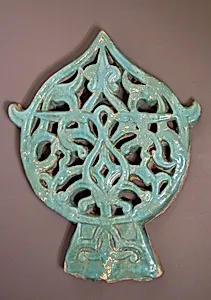
Medium
Fritware, with carved and molded decoration under a turquoise glaze
Dimensions
52.1 × 40.5 × 5.6 cm (20 1/2 × 16 × 2 3/16)
Classification
ceramics
Department
Arts of Asia
Museum
Art Institute of Chicago
Accession Number
15556
Rights
Public Domain
About this artwork
Tiles like this would probably have embellished the tops of fortress walls as decorative projections. The molding process used to make this tile would have allowed for the easy production of identical pieces, an important consideration in a region in which symmetry and repetition were highly valued. The arabesque design, molded in three dimensions, emphasizes the interlacing pattern of elements weaving over and under one another. This decorative feature can also be found in other objects from th...
Art Historical Context
This stunning *Ceramic Architectural Decoration* hails from the 13th century, a golden era of Islamic art in the eastern Mediterranean and Persian regions. Crafted as part of larger architectural ensembles—likely adorning mosques, madrasas, or palaces exemplifies the era's mastery in blending functionality with breathtaking beauty. Measuring 52.1 × 40.5 × 5.6 cm, this panel would have contributed to vast, shimmering tilework facades that caught the light and transformed sacred spaces. Made of fritware—a finely ground quartz-based body invented by Islamic potters to imitate Chinese porcelain's translucency and durability—the piece features intricate carved and molded decorations fired under a vivid turquoise glaze. This technique allowed for deep relief patterns, often geometric or vegetal motifs symbolizing paradise gardens, which were then sealed in glossy color for weather resistance and luminous effect. The turquoise hue, derived from copper oxide, evokes the sky and precious stones, holding deep cultural resonance in Islamic aesthetics. Housed in the Art Institute of Chicago's Arts of Asia department, this ceramic treasure highlights how Islamic artisans elevated everyday materials into expressions of spiritual harmony and technical innovation, influencing global decorative arts for centuries.
About the Artist
Islamic
Islamic art, a profound visual tradition originating in the 7th century CE, flourished across vast territories from Spain to India under Muslim rule, encompassing architecture, ceramics, manuscripts, textiles, and metalwork produced by diverse artisans rather than a single named master. Drawing from pre-Islamic Sasanian, Byzantine, and late antique influences, its early development under the Umayy...