
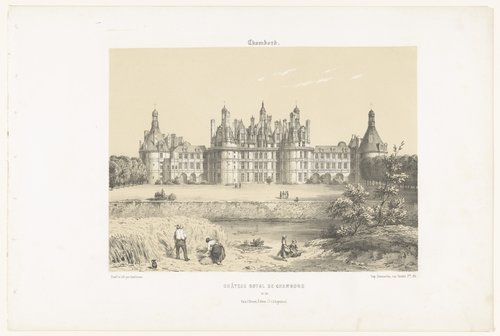
Chambord. Château Royal de Chambord
1853 - 1856
Medium
paper
Dimensions
291; 434
Rights
Public Domain
About this artwork
height 291 mm x width 434 mm
Art Historical Context
Léon Auguste Asselineau’s “Chamb. Château Royal de Chambord” offers a mid-nineteenth-century view of one of France’s most celebrated Renaissance landmarks. Created on paper between 1853 and 1856, the work measures roughly 29 by 43 centimeters, a format well suited to detailed architectural studies that could be widely circulated through prints or albums. The sheet captures the château’s distinctive silhouette—its soaring central keep, elaborate roofline, and surrounding formal landscape—inviting viewers to appreciate both the building’s grandeur and its enduring royal associations. Although little is known about Asselineau’s specific technique from the surviving record, the choice of paper as a support suggests an emphasis on precision and portability. Such works often served as visual records for travelers and scholars during the period when historic monuments were being systematically documented and restored. The resulting image bridges the château’s sixteenth-century origins with the renewed interest in national heritage that flourished under the Second Empire. Visitors today can still sense the quiet authority of the drawing: its measured proportions and careful rendering convey both the monument’s scale and the artist’s respect for its architectural harmony. In this modest sheet, the timeless elegance of Chambord meets the documentary spirit of the 1850s.