
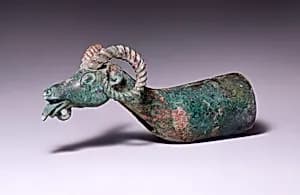
Chariot Pole Ornament with Ram's Head
Unknown Artist
4th century BCE
Medium
Bronze
Dimensions
H. 3 1/4 in. (8.3 cm); L. 7 3/8 in. (18.7 cm); W. 2 1/4 in. (5.7 cm)
Classification
Metalwork
Culture
Northwest China
Department
Asian Art
Museum
Metropolitan Museum of Art, New York, NY
Credit
Gift of Mr. and Mrs. Eugene V. Thaw, 2002
Accession Number
2002.201.56
Rights
Public Domain
Tags
Art Historical Context
This exquisite bronze *Chariot Pole Ornament Ram's Head*, dating to the 4th BCE, hails from the ancient cultures of Northwest China. just over 7 inches long, this finely crafted metalwork piece once adorned the pole of a chariot, a symbol of elite status and military prowess in the region's nomadic and early state societies. The ram's head, rendered with striking realism—curled horns, alert eyes, and textured fur—evokes the animal's enduring symbolism of strength, fertility, and protection across Eurasian steppe traditions. Bronze was a pinnacle medium in ancient China, showcasing advanced lost-wax casting techniques that allowed for intricate details on small-scale objects like this. Such ornaments were not merely functional but also ritualistic, likely enhancing the chariot's prestige during processions or battles amid the Warring States period's turmoil. Discovered in the vast northwestern frontiers, it reflects cultural exchanges along the Silk Road's precursors, blending local motifs with broader influences. Today, this rare artifact graces the Metropolitan Museum of Art's Asian Art department, a generous gift from Mr. and Mrs. Eugene V. Thaw in 2002. It offers visitors a tangible glimpse into the artistry and worldview of a dynamic era, where everyday objects carried profound cultural weight.