
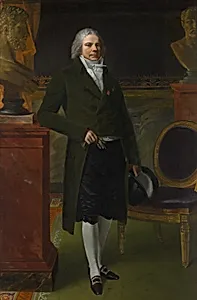
Charles Maurice de Talleyrand Périgord (1754–1838), Prince de Talleyrand
Medium
Oil on canvas
Dimensions
85 x 55 7/8 in. (215.9 x 141.9 cm)
Classification
Paintings
Department
European Paintings
Museum
Metropolitan Museum of Art, New York, NY
Credit
Purchase, Mrs. Charles Wrightsman Gift, in memory of Jacqueline Bouvier Kennedy Onassis, 1994
Accession Number
1994.190
Rights
Public Domain
Tags
Art Historical Context
This striking portrait captures Charles Maurice de Talleyrand-Périgord (1754–1838), one of France's most enigmatic statesmen, painted by Pierre-Paul Prud'hon in 1817. Talleyrand, a shrewd diplomat who navigated the upheavals of the French Revolution, Napoleon's Empire, and the Bourbon Restoration, embodies the era's political intrigue. Commissioned during the Restoration period, the work reflects his enduring influence as Foreign Minister and Prince of Benevento, showcasing his aristocratic poise amid France's turbulent post-Napoleonic recovery. Prud'hon, a master of late Neoclassicism with Romantic tendencies, employs his signature oil-on-canvas technique here on a grand scale (85 x 55⅞ inches). His soft, luminous lighting and fluid brushwork create an ethereal glow around Talleyrand, emphasizing dignity and introspection rather than rigid formality. This blend of idealism and realism highlights Prud'hon's innovative style, bridging David's austerity with emerging emotional depth. Now at The Metropolitan Museum of Art, acquired in 1994 in memory of Jacqueline Bouvier Kennedy Onassis, the painting offers a window into 19th-century European portraiture's role in immortalizing power. Visitors will appreciate how it humanizes a survivor of history's storms.
About the Artist
Pierre Paul Prud'hon · 1758–1823
Pierre Paul Prud'hon (1758–1823) was a French painter and draughtsman whose dreamy, sensuous art occupied a singular position between the Neoclassicism and Romanticism that competed for dominance in French painting around 1800. Born in Cluny in Burgundy, he received his early artistic training at the Dijon Academy before winning the Prix de Rome of the Estates of Burgundy, which allowed him to spe...