
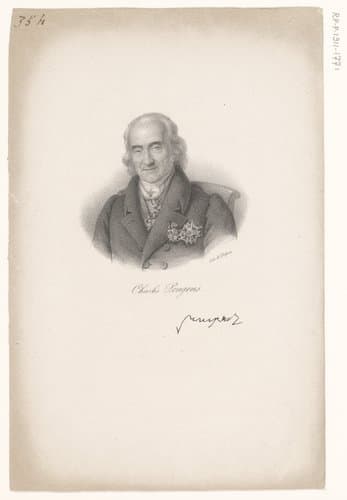
Charles Pougens
in of na 1818 - in of voor 1842
Medium
lithography
Dimensions
271; 178
Rights
Public Domain
About this artwork
lithografie
Art Historical Context
Behold the lithograph *Charles Pougens*, a striking portrait from the early 19th century, produced anonymously but printed by the esteemed veuve Delpech (Naudet). Measuring 271 mm high by 178 mm wide, this work captures the likeness of Charles Pougens, likely a notable figure of his time, rendered with the crisp precision characteristic of lithography. Created around or after 1818 and before 1842, it exemplifies the medium's rise during France's Restoration period, when affordable printmaking democratized access to images of intellectuals, scholars, and public personalities. Lithography, invented just two decades earlier, revolutionized artistic reproduction by allowing artists to draw directly on stone with greasy crayon, producing nuanced tones and fine details without the limitations of engraving. Veuve Delpech's workshop in Paris was a hub for such portraits, blending technical innovation with portraiture's intimate appeal. This technique's significance lay in its speed and scalability, making cultural icons like Pougens accessible to a broader audience beyond elite collectors. As a window into post-Revolutionary France, this lithograph reflects the era's fascination with personal legacy and enlightenment ideals. Visitors, imagine holding a piece of history that bridged handmade art with mass imagery—timeless yet innovative!