
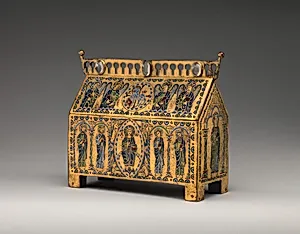
Chasse with Christ in Majesty and the Lamb of God
Unknown Artist
ca. 1180–90
Medium
Champlevé enamel: blue-black; dark, medium, and light blue; turquoise, dark and light green, yellow, red, translucent wine red, and white; wood core, painted red on exterior; copper: engraved, scraped, stippled, and gilt.
Dimensions
Overall: 8 11/16 x 9 1/4 x 4 3/16 in. (22 x 23.5 x 10.7 cm)
Classification
Enamels-Champlevé
Culture
French
Department
Medieval Art
Museum
Metropolitan Museum of Art, New York, NY
Credit
Gift of J. Pierpont Morgan, 1917
Accession Number
17.190.523
Rights
Public Domain
Tags
Art Historical Context
Step into the luminous world of medieval French craftsmanship with the *Chasse with Christ in Majesty and the of God*, a exquisite reliquary crafted around 1180–90. This small, box-like chasse—measuring just 8 11/16 x 9 1/4 x 4 3/16 inches designed to house sacred relics, such as fragments of saints' bones, and was likely carried in processions or displayed on altars. The front features a majestic Christ enthroned in glory, flanked by angels, with the symbolic Lamb of God below, embodying core Christian themes of divine authority, sacrifice, and redemption during the Romanesque era's spiritual fervor. The artwork's brilliance comes from champlevé enamel, a sophisticated technique where artisans engraved troughs into a copper base, filled them with vibrant powdered glass enamels in shades of blue-black, turquoise, greens, yellows, reds, and white, then fired them to fuse the colors. A painted red wood core provided structure, while engraved, stippled, and gilt copper accents added intricate details. This method, perfected in 12th-century Limoges workshops, allowed for jewel-like durability and glow, making reliquaries portable treasures that rivaled church jewels. Donated to the Metropolitan Museum of Art in 1917 by J. Pierpont Morgan, this anonymous masterpiece highlights France's medieval enamel mastery, bridging art and devotion in an age when such objects inspired awe and pilgrimage. Its survival offers a vivid window into the era's piety and technical innovation.