
Château d'Happegienne
1830–60
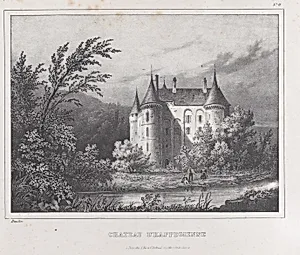
Medium
Lithograph
Dimensions
Image: 7 1/16 × 9 9/16 in. (17.9 × 24.3 cm) Sheet: 10 3/16 × 13 3/4 in. (25.8 × 35 cm)
Classification
Prints
Department
Drawings and Prints
Museum
Metropolitan Museum of Art, New York, NY
Credit
The Elisha Whittelsey Collection, The Elisha Whittelsey Fund, 1960
Accession Number
60.624.86
Rights
Public Domain
Art Historical Context
Step into the elegant world of 19th-century European architecture with *Château d'Happeienne*, a finely detailed lithograph created between 1830 and 1860 by F. Dubreuil (or an anonymous artist). This print the grand silhouette of the château, likely a stately French or Belgian estate, rendered with the precision that made lithography a beloved medium of the era. Invented just decades earlier, lithography allowed artists to draw directly on stone with greasy crayon, producing multiple high-quality impressions ideal for disseminating views of picturesque landmarks to a growing middle-class audience eager for travel souvenirs and cultural keepsakes. Measuring about 7 by 9 ½ inches, this image exemplifies the Romantic fascination with historic châteaux—their towers, facades, and landscaped grounds evoking timeless nobility amid France's July Monarchy and beyond. As part of The Metropolitan Museum of Art's Elisha Whittelsey Collection, it highlights the technical artistry of printmaking, where subtle tonal gradations mimic watercolor effects. Though modest in scale, *Château d'Happegienne* offers a window into an age when such prints bridged art and documentation, preserving architectural heritage for generations of admirers.
About the Artist
Anonymous|F. Dubreuil
In the vast tapestry of art history, "Anonymous" stands not as a singular individual but as a collective designation for countless unidentified creators whose works have endured across millennia. These artists, spanning prehistoric cave painters to medieval illuminators and folk craftsmen, produced the foundational layers of human visual culture. Prior to the Renaissance, when individual fame emer...