
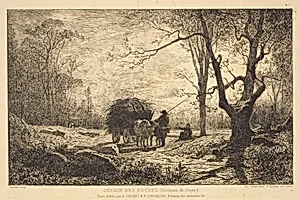
Chemin des Roches
1801 to 1825
Medium
etching
Classification
Department
CG-E
Museum
National Gallery of Art, Washington, D.C.
Credit
Ailsa Mellon Bruce Fund
Accession Number
1975.34.10.b
Rights
Public Domain
Art Historical Context
Adolphe Appian’s “Chemin des Roches,” an etching created between 1801 and 1825, offers a quiet glimpse of a rocky path winding through nature. As a printmaker, Appian used the etching technique to render lines and subtle tonal variations allowing him to capture the textures of stone and foliage with remarkable precision. This medium was especially valued in the early nineteenth century for its ability to produce multiple impressions, making detailed landscape views accessible beyond the original drawing or painting. Housed in the National Gallery of Art’s collection through the Ailsa Mellon Bruce Fund, the work reflects the period’s growing appreciation for intimate, unidealized scenes of the natural world. Etchings like this one played an important role in disseminating artistic images to a broader public, bridging the gap between studio practice and wider cultural interest in the countryside. Visitors can appreciate how the artist’s careful line work invites quiet contemplation of the path’s rugged beauty.
About the Artist
Adolphe Appian · 1818–1898
Adolphe Appian, born Jacques Barthélemy Adolphe Appian in Lyon, France, on August 28, 1819, began his artistic training at the age of fifteen at the École des Beaux-Arts de Lyon. There, he studied under the landscape painters Jean-Michel Grobon and Augustin Alexandre Thierrat, initially focusing on fabric decoration for the city's thriving silk industry. This practical grounding in drawing honed h...