
Cherub's head
Unknown Artist
second half 18th century
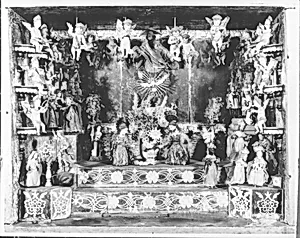
Medium
Wood, polychromed and gilt
Dimensions
H. ca. 4 in. (10.2 cm)
Classification
Crèche figure
Culture
probably Ecuadoran, Quito
Department
The American Wing
Museum
Metropolitan Museum of Art, New York, NY
Credit
Gift of Loretta Hines Howard, 1964
Accession Number
64.164.203
Rights
Public Domain
Art Historical Context
This delicate *Cherub's Head*, carved from wood in the second half of the 18th century, exemplifies the exquisite craftsmanship of the Quito School in colonial Ecuador. Standing just 4 inches tall, the cherub—likely part of a larger church altarpiece or decorative ensemble—features a youthful, angelic face with softly rounded cheeks and flowing curls, rendered in vibrant polychrome paints and shimmering gilding. These techniques, common in Latin American colonial art, involved layering pigments over gesso to mimic lifelike skin tones and fabrics, while gold leaf added divine radiance, evoking heavenly splendor. Originating from Quito, a thriving center of Baroque sculpture under Spanish rule, this piece reflects the fusion of European artistic traditions with local indigenous and mestizo skills. Workshops there produced thousands of religious figures for cathedrals and convents, blending dramatic realism with emotional expressiveness to inspire devotion. Though the artist remains unknown, the work's refined detailing highlights the era's mastery of small-scale sculpture. Today, housed in The Metropolitan Museum of Art's American Wing as a gift from Loretta Hines Howard in 1964, it offers a glimpse into colonial South America's artistic legacy, bridging continents and faiths in a single, enchanting form.