
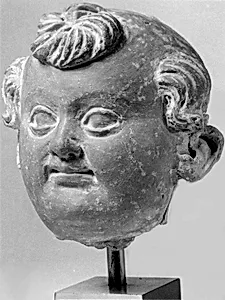
Cherubic Head
Unknown Artist
ca. 5th century
Medium
Terracotta
Dimensions
H. 4 1/2 in. (11.5 cm)
Classification
Sculpture
Culture
Pakistan (ancient region of Gandhara)
Department
Asian Art
Museum
Metropolitan Museum of Art, New York, NY
Credit
Gift of Cynthia Hazen Polsky, 1987
Accession Number
1987.424.23
Rights
Public Domain
Tags
Art Historical Context
This delightful terracotta *Cherubic Head*, dating to around the 5th century hails from the ancient Gandhara region in what is now Pakistan. Standing just 4½ inches (11.5 cm) high, this small-scale sculpture captures a youthful, plump face with an endearing, almost angelic expression—evoking the cherubs of later artistic traditions. Crafted by an unknown artist, it exemplifies the intimate, portable devotional art produced in this culturally vibrant crossroads. Gandhara was a melting pot of influences, where Hellenistic Greek styles from Alexander the Great's legacy mingled with local Indian and Central Asian traditions, particularly in Buddhist sculpture. Though modest in size, this head reflects the region's mastery of realistic facial modeling, with soft contours and serene features that suggest spiritual innocence, possibly linked to child-like deities or guardian figures common in Gandharan iconography. Terracotta, a fired clay medium, was prized for its affordability and versatility, allowing artisans to achieve fine details through hand-building and modeling before firing. Likely used in architectural decoration or household shrines, this piece now graces the Metropolitan Museum of Art's Asian Art department, a generous 1987 gift from Cynthia Hazen Polsky. It invites us to ponder the tender humanity in ancient spiritual art.