
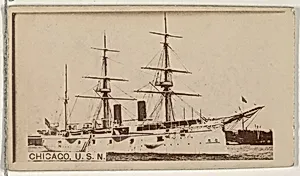
Chicago, U.S.N., from the Famous Ships series (N50) for Virginia Brights Cigarettes
1895
Medium
Albumen photograph
Dimensions
Sheet: 1 1/2 x 2 5/8 in. (3.8 x 6.7 cm)
Classification
Photographs|Ephemera
Department
Drawings and Prints
Museum
Metropolitan Museum of Art, New York, NY
Credit
The Jefferson R. Burdick Collection, Gift of Jefferson R. Burdick
Accession Number
63.350.203.50.32
Rights
Public Domain
Tags
Art Historical Context
This petite albumen photograph, titled *Chicago, U.S.N.*, is a gem from Allen & Ginter's *Famous Ships* series (N50), issued in 1895 with Virginia Bright Cigarettes. Measuring just 1 1/2 x 2 5/8 inches, it captures the majestic USS *Chicago*, a protected cruiser commissioned by the U.S. Navy in 1889 as one of its first steel warships. These cards were part of a booming trend in the late 19th century, where tobacco companies like Allen & Ginter—pioneers of the modern cigarette card—distributed collectible inserts to boost sales and foster a passionate trading culture among enthusiasts. Printed via the albumen process, which yielded rich tones and fine detail from silver salts on paper, this ephemera reflects both technological innovation and imperial ambition. Albumen prints were the gold standard for photography then, making naval icons accessible in everyday pockets. The *Chicago* symbolized America's growing maritime power during a era of naval expansion under Theodore Roosevelt's influence, evoking pride in U.S. seafaring heritage. Housed in The Metropolitan Museum of Art's Jefferson R. Burdick Collection, this card bridges art, history, and commerce, reminding us how everyday objects immortalized the era's giants of the sea. A delightful window into Victorian collecting mania!
About the Artist
Allen & Ginter
Allen & Ginter, the pioneering American tobacco firm based in Richmond, Virginia, emerged around 1880 from the partnership of John F. Allen and Lewis Ginter, evolving from Allen's earlier John F. Allen & Company. Allen retired in 1882, succeeded by John Pope, yet the brand endured under Ginter's leadership, employing over 1,100 workers—mostly women—for hand-rolled cigarettes by 1886. Ginter, a Dut...