
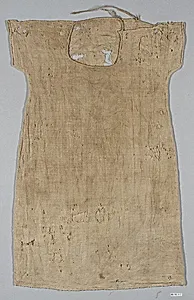
Child's Tunic
Unknown Artist
5th–9th century
Medium
Wool, linen; plain weave
Classification
Textiles
Department
Islamic Art
Museum
Metropolitan Museum of Art, New York, NY
Credit
Purchase by subscription, 1889
Accession Number
89.18.317
Rights
Public Domain
Art Historical Context
Nestled in the Metropolitan Museum of Art's Islamic collection, this *Child's Tunic* to the 5th–9th century, a formative era bridging Late Antiquity and the early Islamic world. Crafted from wool and linen using plain weave—a straightforward technique where warp and weft threads interlace in a simple over-under pattern—this garment exemplifies the practical artistry of ancient textile production. Acquired through subscription purchase in 1889, it offers a rare glimpse into everyday life, when such tunics were essential clothing for children across regions like Egypt, Syria, or Mesopotamia. The use of wool for warmth and durability alongside linen's breathability highlights the weavers' resourcefulness with locally sourced fibers, common in pre-modern Islamic societies. Plain weave was ideal for garments needing flexibility and strength, allowing for mass production via looms that supported vibrant trade networks. As a child's tunic, it reveals tender details of family and childhood: likely sized for a young wearer, it underscores how textiles wove together utility, culture, and commerce in early Islamic civilizations. Though the artist remains unknown, this piece's survival speaks to the enduring value of textiles in Islamic heritage, where clothing preserved social norms and craftsmanship. Visitors can appreciate how such humble artifacts illuminate the human stories behind grand historical shifts.