
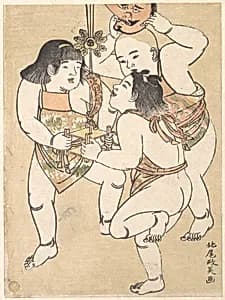
Children in the Sanno Festival
ca. 1790
Medium
Woodblock print; ink and color on paper
Dimensions
H. 8 5/8 in. (21.9 cm); W. 6 3/8 in. (16.2 cm)
Classification
Prints
Culture & Period
Japan · Edo period (1615–1868)
Department
Asian Art
Museum
Metropolitan Museum of Art, New York, NY
Credit
Gift of Estate of Samuel Isham, 1914
Accession Number
JP938
Rights
Public Domain
Tags
Art Historical Context
"Children in the Sanno," created around 1790 by Kuwagataisai, captures the lively spirit of one of Edo-period Japan's most beloved events. This charming woodblock print depicts young boys and girls immersed in the vibrant Sanno Matsuri, a Shinto procession honoring the deity of Mount Sanno. Keisai, a master of ukiyo-e "pictures of the floating world" genre—excelled at portraying everyday joys, festivals, and urban life in Tokyo (then Edo), making scenes like this accessible to a wide audience through affordable prints. Printed with ink and color on paper using intricate woodblock techniques, the artwork's modest size (about 8½ by 6½ inches) suggests it may have been part of a series or album, ideal for personal collection. Multiple carved woodblocks were layered to achieve rich hues and fine details, from the children's colorful robes to their playful expressions, highlighting the technical prowess of Edo artisans. This medium democratized art, bringing festival excitement into homes. During the Edo period (1615–1868), such festivals were communal highlights, blending religion, spectacle, and community bonding. Keisai's focus on innocent childhood revelry reflects the era's fascination with fleeting pleasures, offering visitors a window into Japan's harmonious blend of tradition and exuberance. A delightful glimpse of history!