
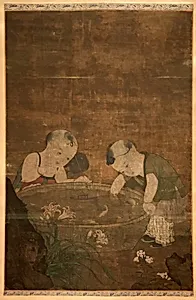
明 佚名 絹本設色 童子戯魚圖 軸|Children Playing
16th–17th century
Medium
Hanging scroll; ink and color on silk
Dimensions
Image: 37 1/2 x 25 1/4 in. (95.3 x 64.1 cm)
Classification
Paintings
Culture & Period
China · Ming dynasty (1368–1644)
Department
Asian Art
Museum
Metropolitan Museum of Art, New York, NY
Credit
Charles Stewart Smith Collection, Gift of Mrs. Charles Stewart Smith, Charles Stewart Smith Jr., and Howard Caswell Smith, in memory of Charles Stewart Smith, 1914
Accession Number
14.76.4
Rights
Public Domain
Art Historical Context
This delightful hanging scroll, titled *Children Playing* (童子戯魚圖), captures the joyful innocence of youth in late Ming dynasty China (16th–17th century). Created by an artist, it depicts children gleefully interacting with fish, a motif rich in symbolism. In Chinese culture, fish represent abundance and prosperity— their name "yu" (魚) echoes "surplus" (餘)—while playful children evoke wishes for family harmony, fertility, and good fortune. Such scenes were popular in decorative arts, adorning homes or studios during festivals. Painted in ink and color on silk (絹本設色), the work exemplifies the Ming era's mastery of gongbi technique: meticulous brushwork with vibrant pigments that bring the lively figures and rippling water to life. Silk's luminous surface enhances the colors' depth, making it ideal for hanging scrolls unrolled for admiration. This medium, favored by scholar-artists, reflects the period's refined literati aesthetic amid the dynasty's cultural flourishing before its fall in 1644. Now in the Metropolitan Museum of Art's Asian Art collection, gifted in 1914 from the Charles Stewart Smith family, the scroll (37½ × 25¼ in.) invites viewers to ponder everyday bliss amid imperial grandeur—a timeless reminder of childhood's universal charm.
About the Artist
Unidentified ( ) · –