
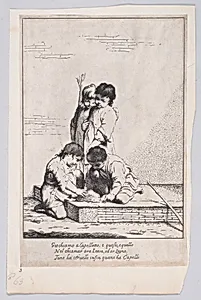
Children playing "à Capelletto"
1705–15
Medium
Etching
Dimensions
Sheet (Trimmed): 8 13/16 × 5 13/16 in. (22.4 × 14.8 cm)
Classification
Prints
Department
Drawings and Prints
Museum
Metropolitan Museum of Art, New York, NY
Credit
Gift of Mr. Hans Calman, 1965
Accession Number
65.568.1
Rights
Public Domain
Tags
Art Historical Context
Giuseppe Maria Crespi, a prominent Bolognese artist of the late Baroque period, captures the joy of childhood in his etching *Children playing "à Capletto"* (1705–15). This intimate print depicts young children engaged in a traditional Italian game, likely involving tossing or aiming at a "capelletto" (a small hat or cap),oking the lively street play of 18th-century Italy.pi, known for his genre scenes of everyday life, brings a of warmth and realism to these moments, reflecting the Baroque interest in human emotion and naturalism. As an etching—a printmaking technique where acid bites into a metal plate to create fine, expressive lines—this work showcases Crespi's mastery of tonal contrasts and intricate details within its modest dimensions (8 13/16 × 5 13/16 in.). Etchings like this were popular for their affordability, allowing wider dissemination of an artist's vision beyond oil paintings. Housed in the Metropolitan Museum of Art's Drawings and Prints department, it highlights Crespi's skill in translating his painterly style to print, blending humor and tenderness. This piece offers a charming glimpse into historical pastimes, reminding us how games like "à Capelletto" fostered community and imagination among children in early modern Europe. A gift to the Met in 1965, it invites visitors to appreciate the universal delight in play across centuries.
About the Artist
Giuseppe Maria Crespi · 1665–1747
Giuseppe Maria Crespi (1665–1747) was an Italian painter of the late Baroque period whose innovative genre scenes and unorthodox approach to religious painting made him one of the most original artists of early eighteenth-century Bologna. Born in Bologna, he trained under Domenico Maria Canuti, Carlo Cignani, and in the tradition of the Carracci academy, but developed a markedly personal style tha...