
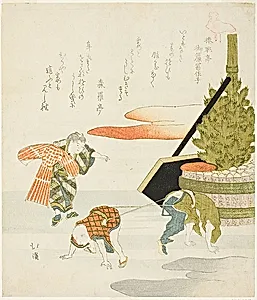
Children Playing Tug of War
early 19th century
Medium
Color woodblock print; surimono
Dimensions
20.8 × 18 cm (8 1/4 × 7 1/8 in.)
Classification
woodblock print
Department
Arts of Asia
Museum
Art Institute of Chicago
Accession Number
81035
Rights
Public Domain
Art Historical Context
In the playful woodblock print *Children Playing Tug of War*, Totoya Hokkei captures a moment of youthful exuberance from early 19th-century Japan Created during the Edo period, this intimate surimono—a luxurious, privately commissioned print often produced for New Year's greetings or special occasions—depicts children gleefully pulling on a rope, their dynamic poses conveying pure joy and camaraderie. Hok, a skilled ukiyo-e artist by masters like Hokusai, excelled in these small-format works (just 20.8 × 18 cm), which allowed for exquisite detail and vibrant colors achieved through meticulous woodblock carving and printing techniques. Surimono like this one stand out for their opulence: subtle embossing, metallic pigments, and crisp lines elevated them beyond standard ukiyo-e, making them cherished keepsakes among Japan's literati and merchants. This genre scene reflects the ukiyo-e tradition of celebrating everyday life—"the floating world"—while highlighting children's games as a universal symbol of innocence and community bonding, possibly evoking festival traditions. Housed in the Art Institute of Chicago's Arts of Asia collection, Hokkei's print invites us to appreciate the artistry of Edo-era printing, where collaboration among carvers, printers, and publishers produced enduring cultural treasures. A delightful glimpse into Japan's whimsical past!
About the Artist
Totoya Hokkei · 1780–1850
Totoya Hokkei (魚屋 北渓, 1780–1850), born Iwakubo Tatsuyuki in Edo (modern Tokyo), began his life as a humble fishmonger in the Yotsuya Samegahashi district, a trade reflected in his art name "Totoya," meaning fish shop. He transitioned to art through rigorous training, first studying under Kanō Yōsen'in Korenobu, head of the Kobikichō branch of the prestigious Kanō school, where he honed landscape p...