
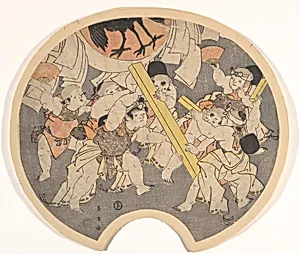
Children's Lantern Float, Sanno Festival
ca. 1788
Medium
Woodblock print; uchiwa fan format; ink and color on paper
Dimensions
W. 10 1/4 in. (26 cm)
Classification
Prints
Culture & Period
Japan · Edo period (1615–1868)
Department
Asian Art
Museum
Metropolitan Museum of Art, New York, NY
Credit
Rogers Fund, 1922
Accession Number
JP1401
Rights
Public Domain
Tags
Art Historical Context
Step into the vibrant world of-period Japan with *Children's Lantern Float, Sanno Festival* Katsukawa Shun'eica. 1788). This charming woodblock print captures a moment from the Sanno Festival, one of's (then Edo's) grandest annual celebrations honoring the deity at Sanno Shrine. Parades featuring massive floats, like this lantern-bearing one carried by exuberant boys, drew crowds for days of music, dance, and communal revelry during the summer months. Shun'ei, a master of the ukiyo-e ("pictures of the floating world") tradition from the Katsukawa school, expertly conveys the festival's lively energy through dynamic poses and festive attire. Printed in ink and color on paper in the distinctive uchiwa fan format—measuring just 10¼ inches wide—this artwork was designed as both art and functional object, often used to cool oneself amid the summer heat. The uchiwa-e style allowed artists like Shun'ei to showcase bold compositions suited to the fan's rounded shape, with intricate details in the boys' kimonos, glowing lanterns, and architectural backdrop highlighting the woodblock technique's precision: multiple carved blocks layered for vivid hues and textures. Held during the Edo period (1615–1868), when urban culture thrived, such prints democratized festival scenes for everyday viewers. Today, at the Metropolitan Museum of Art (Rogers Fund, 1922), it evokes the innocent delight of children in tradition, reminding us of Japan's enduring love for matsuri—festivals that bind community and spirit. (198 words)
About the Artist
Katsukawa Shun'ei 勝川春英 (Japanese) · 1762 –1819
Japanese, 1762–1819