
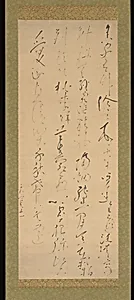
良寛大愚筆 五語詩「余家有竹林」|Chinese Poem: “There is a bamboo grove around my house”
early 19th century
Medium
Hanging scroll; ink on paper
Dimensions
Image: 49 7/16 × 19 1/16 in. (125.6 × 48.4 cm) Overall with mounting: 81 9/16 × 24 in. (207.2 × 61 cm) Overall with knobs: 81 9/16 × 26 in. (207.2 × 66 cm)
Classification
Calligraphy
Culture & Period
Japan · Edo period (1615–1868)
Department
Asian Art
Museum
Metropolitan Museum of Art, New York, NY
Credit
Mary and Cheney Cowles Collection, Gift of Mary and Cheney Cowles, 2018
Accession Number
2018.853.29
Rights
Public Domain
Art Historical Context
This hanging scroll by Ryōkan Taigu (1758–1831), a beloved Zen monk, poet, and calligrapher of Japan’s Edo period, a moment of quiet reflection both word and brush. The work presents a short Chinese poem—“There is a bamboo grove around my house”—rendered in Ryōkan’s distinctive hand. Known affectionately as “Taigu” or “Great Fool,” the artist lived a simple, itinerant life, often begging for food and composing verses that celebrate nature’s unadorned beauty. His calligraphy here embodies the Zen ideal of spontaneity, with fluid, unpretentious strokes that seem to flow as naturally as the bamboo he describes. Created in the early nineteenth century as ink on paper, the scroll format was traditionally used for displaying poetry or religious texts in Japanese interiors, allowing viewers to appreciate both the literary content and the expressive quality of the brushwork. Ryōkan’s style avoids rigid formality, favoring irregular rhythms and generous spacing that convey warmth and humility rather than technical perfection. Today, this piece in the Metropolitan Museum’s collection reminds visitors of the deep connection between Zen practice, poetry, and the visual arts in Edo-period Japan. The gentle poem and its lively inscription together invite us to pause and imagine the peaceful grove that inspired one of Japan’s most cherished literary and artistic figures.