
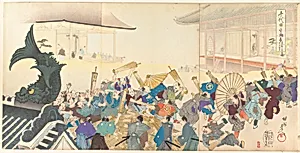
Chiyoda Castle (Album of Men)
Medium
Triptych of woodblock prints; ink and color on paper
Dimensions
L. (page) 13 7/8 in. (35.2 cm); W. (page) 9 1/4 in. (23.4 cm); thickness of album 1 9/16 in. (4 cm)
Classification
Prints
Culture & Period
Japan · Meiji period (1868–1912)
Department
Asian Art
Museum
Metropolitan Museum of Art, New York, NY
Credit
Gift of Mrs. W. Walton Butterworth, 1979
Accession Number
JP3563
Rights
Public Domain
Tags
Art Historical Context
Yōshū Chikanobu’s *Chiyoda Castle (Album of Men)*, created in 1897 during Japan’s Meiji period, offers a vivid glimpse into scenes associated with the historic Edo Castle complex, now known as the Tokyo Imperial Palace. Rendered as a triptych of woodblock prints in ink and color on paper, the work belongs to an album format that allowed viewers to unfold and contemplate multiple moments at once. Chikanobu, a leading ukiyo-e artist of the late nineteenth century, specialized in such panoramic compositions that blended historical nostalgia with the refined printmaking techniques perfected during the Edo era. The album’s focus on male figures amid houses, crowds, and everyday details such as fish reflects the artist’s interest in recording the rhythms of castle life just as Japan was transforming under modernization. Woodblock triptychs like this one enabled expansive storytelling within a portable format, their layered colors and precise linework capturing both architectural grandeur and human activity. Gifted to the Metropolitan Museum in 1979, the print remains a compelling example of Meiji-era printmaking that preserved collective memory of Japan’s feudal past for new generations.
About the Artist
Yōshū (Hashimoto) Chikanobu · 1838–1912
Toyohara Chikanobu, born Hashimoto Naoyoshi in 1838 in Echigo Province (modern Niigata Prefecture), emerged as one of the last great ukiyo-e masters during Japan's Meiji era. The son of a low-ranking samurai retainer to the Sakakibara clan, he trained initially in the Kanō school of painting before turning to ukiyo-e printmaking. He studied under a disciple of Keisai Eisen, then joined the studio ...