
Chiyoda Castle (Album of Men)
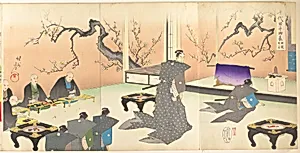
Medium
Triptych of woodblock prints; ink and color on paper
Dimensions
L. (page) 13 7/8 in. (35.2 cm); W. (page) 9 1/4 in. (23.4 cm); thickness of album 1 9/16 in. (4 cm)
Classification
Prints
Culture & Period
Japan · Meiji period (1868–1912)
Department
Asian Art
Museum
Metropolitan Museum of Art, New York, NY
Credit
Gift of Mrs. W. Walton Butterworth, 1979
Accession Number
JP3570
Rights
Public Domain
Tags
Art Historical Context
Yōshū Chikanobu’s “Chiyoda Castle (Album of Men)” offers a vivid glimpse into late-19th-century Japanese printmaking. Created in 1897 during the Meiji period, this triptych of woodblock prints captures scenes of men engaged in writing and courtly activities within the historic grounds of Chiyoda Castle, the former seat of the Tokugawa shoguns and later the imperial residence. Chikanobu, a leading ukiyo-e artist of his day, often blended traditional subjects with the refined techniques of the floating-world school, even as Japan underwent rapid modernization. The work’s format—a set of three coordinated sheets forming a single panoramic image—highlights the narrative possibilities of Japanese woodblock printing. Ink and color applied to paper allow for crisp lines and delicate gradations, while the album format suggests the piece was designed for private viewing and repeated enjoyment. Though the tags emphasize figures and the act of writing, the composition reflects Chikanobu’s interest in preserving images of aristocratic and official life just as those traditions were evolving. Housed in the Metropolitan Museum’s Asian Art department, the print serves as both an artistic treasure and a cultural document. It reminds viewers how Meiji-era artists used time-honored media to record a changing Japan, inviting today’s audiences to appreciate the quiet dignity of these historical figures.
About the Artist
Yōshū (Hashimoto) Chikanobu · 1838–1912
Toyohara Chikanobu, born Hashimoto Naoyoshi in 1838 in Echigo Province (modern Niigata Prefecture), emerged as one of the last great ukiyo-e masters during Japan's Meiji era. The son of a low-ranking samurai retainer to the Sakakibara clan, he trained initially in the Kanō school of painting before turning to ukiyo-e printmaking. He studied under a disciple of Keisai Eisen, then joined the studio ...