
Chiyoda Castle (Album of Men)
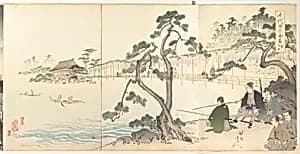
Medium
Triptych of woodblock prints; ink and color on paper
Dimensions
L. (page) 13 7/8 in. (35.2 cm); W. (page) 9 1/4 in. (23.4 cm); thickness of album 1 9/16 in. (4 cm)
Classification
Prints
Culture & Period
Japan · Meiji period (1868–1912)
Department
Asian Art
Museum
Metropolitan Museum of Art, New York, NY
Credit
Gift of Mrs. W. Walton Butterworth, 1979
Accession Number
JP3583
Rights
Public Domain
Tags
Art Historical Context
Created during Japan’s Meiji period (1868–1912), this triptych of woodblock prints by Yōshū Chikanobu captures a tranquil scene associated with Chiyoda Castle, the historic seat of the Tokugawa shoguns in Tokyo. Rendered in ink and color on paper, the work belongs to the artist’s “Album of Men” series, which presents male figures engaged in everyday activities amid the castle’s surrounding landscape. The tags suggest a peaceful setting of houses, trees, boats, and fishing, reflecting the enduring appeal of traditional Japanese scenery even as the nation modernized. Chikanobu, a leading ukiyo-e artist of the late nineteenth century, employed the collaborative woodblock technique—where designers, carvers, and printers worked together—to achieve vibrant colors and fine detail. Such prints were affordable and widely circulated, allowing viewers across social classes to enjoy images of famous places. The album format further enhanced this accessibility, inviting leisurely viewing of multiple scenes. Today housed in the Metropolitan Museum of Art’s Asian Art collection, the triptych offers a window into Meiji-era cultural life, where artists like Chikanobu bridged centuries-old printmaking traditions with contemporary subjects. Its gift by Mrs. W. Walton Butterworth in 1979 ensures these delicate impressions continue to educate visitors about Japan’s artistic heritage.
About the Artist
Yōshū (Hashimoto) Chikanobu · 1838–1912
Toyohara Chikanobu, born Hashimoto Naoyoshi in 1838 in Echigo Province (modern Niigata Prefecture), emerged as one of the last great ukiyo-e masters during Japan's Meiji era. The son of a low-ranking samurai retainer to the Sakakibara clan, he trained initially in the Kanō school of painting before turning to ukiyo-e printmaking. He studied under a disciple of Keisai Eisen, then joined the studio ...