
Chiyoda Castle (Album of Women)
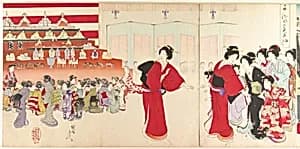
Medium
Triptych of woodblock prints; ink and color on paper
Dimensions
L. (page) 13 7/8 in. (35.2 cm); W. (page) 9 1/4 in. (23.4 cm)
Classification
Prints
Culture & Period
Japan · Meiji period (1868–1912)
Department
Asian Art
Museum
Metropolitan Museum of Art, New York, NY
Credit
Gift of Mrs. W. Walton Butterworth, 1979
Accession Number
JP3529
Rights
Public Domain
Tags
Art Historical Context
**Chiyoda Castle (Album of Women)**, created by the renowned ukiyo-e master Yōshū (Hashimoto) Chikanobu 1895, captures a vibrant scene from Japan's Meiji period (1868–1912). This triptych of woodblock prints, rendered in vivid ink and color on paper likely depicts a lively crowd of women at Chiyoda Castle—once the heart of Edo Castle and imperial residence. Chikanobu, known for his dynamic compositions blending historical themes with elegant female figures (bijin-ga), showcases the grace and energy of everyday life amid Japan's rapid modernization. The triptych format, a hallmark of ukiyo-e artistry, allows for a panoramic view, unfolding across three sheets to immerse viewers in the bustling atmosphere. Woodblock printing techniques—precise carving of blocks for layered colors and intricate details—highlight the medium's accessibility, making high art available to the masses through affordable prints. Each 13⅞ × 9¼-inch page exemplifies the meticulous craftsmanship that defined late 19th-century Japanese printmaking. As part of the Metropolitan Museum of Art's Asian Art collection, this work reflects Meiji-era tensions between tradition and Western influence, celebrating women's roles in a transforming society. A gift from Mrs. W. Walton Butterworth in 1979, it invites us to ponder the enduring allure of crowded, communal moments in Japanese culture.
About the Artist
Yōshū (Hashimoto) Chikanobu · 1838–1912
Toyohara Chikanobu, born Hashimoto Naoyoshi in 1838 in Echigo Province (modern Niigata Prefecture), emerged as one of the last great ukiyo-e masters during Japan's Meiji era. The son of a low-ranking samurai retainer to the Sakakibara clan, he trained initially in the Kanō school of painting before turning to ukiyo-e printmaking. He studied under a disciple of Keisai Eisen, then joined the studio ...