
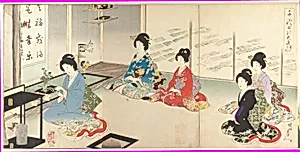
千代田の大奥 茶の湯辺り花|Chiyoda Inner Palace: No.20 Flower Arranging in Turn (Chiyoda no Ōoku: Chanoyu mawaribana)
August 1895
Medium
Triptych of woodblock prints; ink and color on paper
Dimensions
L. (page) 13 7/8 in. (35.2 cm); W. (page) 9 1/4 in. (23.4 cm)
Classification
Prints
Culture & Period
Japan · Meiji period (1868–1912)
Department
Asian Art
Museum
Metropolitan Museum of Art, New York, NY
Credit
Gift of Mrs. W. Walton Butterworth, 1979
Accession Number
JP3539.1, .2
Rights
Public Domain
Tags
Art Historical Context
Step into the refined world of Japan's Meiji era with Hashimoto Chikanobu's *Chiyoda no Ōoku: Chanoyu mawaribana* (Chiyoda Inner Palace: No. 20 Flower Arranging in Turn), a captivating triptych woodblock print from August 1895. This vibrant work, part of a renowned series depicting daily life in the Ōoku—the secluded women's quarters of Edo Castle (today's Tokyo Imperial Palace)—shows elegant ladies gracefully arranging flowers amid a tea ceremony. Chikanobu, a master of ukiyo-e, skillfully captures their poise and beauty, blending historical nostalgia with the era's modernization. Created during the Meiji period (1868–1912), when Japan rapidly westernized yet preserved cultural traditions, the print highlights the Ōoku's role as a center of refinement for shogunal consorts and attendants. Tea ceremonies and ikebana (flower arranging) symbolized harmony, discipline, and aesthetic sensibility, offering a glimpse into elite feminine spheres amid political upheaval. The triptych format—three panels uniting into a panoramic scene—exemplifies woodblock printing's ingenuity: intricate carving, layered color application, and paper sizing for depth and luminosity. Measuring about 14 x 28 inches when assembled, this Metropolitan Museum of Art treasure (gift of Mrs. W. Walton Butterworth, 1979) invites visitors to savor the artistry of women in a transforming Japan.