
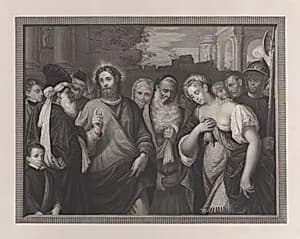
Christ and the adulteress
1830–83
Medium
Engraving
Dimensions
Plate: 12 11/16 × 14 15/16 in. (32.3 × 38 cm) Sheet: 15 3/4 × 21 9/16 in. (40 × 54.8 cm)
Classification
Prints
Department
Drawings and Prints
Museum
Metropolitan Museum of Art, New York, NY
Credit
The Elisha Whittelsey Collection, The Elisha Whittelsey Fund, 1947
Accession Number
47.100.343
Rights
Public Domain
Art Historical Context
In the Prints gallery, behold Carlo Raimondi's *Christ and the Adulteress (1830–83), a finely wrought engraving capturing a pivotal biblical moment from the Gospel of John (8:1–11). Here, Jesus intervenes as scribes and Pharisees confront a woman accused of adultery, challenging the crowd with his famous words: "Let him who is sin among you be the first to throw a stone at her." Raimondi, an Italian engr active in the 19th century, masterfully renders this scene of mercy and moral introspection, drawing on Renaissance and Baroque traditions of religious narrative art. Crafted as an engraving—a labor-intensive intaglio technique where the artist incises intricate lines into a metal plate, inks it, and presses paper to capture the image—this work exemplifies the medium's precision and tonal depth. Measuring 12 11/16 × 14 15/16 inches on the plate, it allowed for detailed reproductions that brought sacred stories to wider audiences beyond oil paintings. Prints like this democratized art during the Romantic era, blending spiritual drama with technical virtuosity. Acquired through The Elisha Whittelsey Collection at The Metropolitan Museum of Art in 1947, this piece invites reflection on forgiveness amid judgment, a timeless theme resonating across cultures. A testament to engraving's enduring legacy, it rewards close viewing for its subtle textures and emotional intensity.