
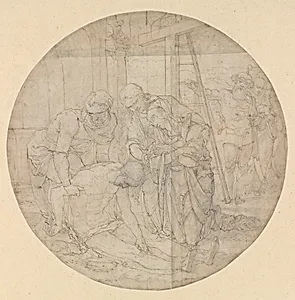
Christ at the Foot of the Cross, Mourned by Mary and John
early 16th century
Medium
Pen and brown ink and wash with traces of black chalk, on three joined sheets of paper, circular. Verso: black chalk
Dimensions
13 in. (33 cm) in diameter
Classification
Drawings
Department
Drawings and Prints
Museum
Metropolitan Museum of Art, New York, NY
Credit
Purchase, Didier Aaron Gift, 2002
Accession Number
2002.422
Rights
Public Domain
Tags
Art Historical Context
In the early 16th century, artist Aertgen Claesz. Leyden (or possibly Nicolaas Hogenberg) captured a moment of profound sorrow in *Christ at the Foot of Cross, Mourned Mary and John*. This drawing depicts the Virgin Mary and Saint John grieving over Christ's body in a Pietà-like scene, evoking the raw emotion of the Descent from Cross. Created during the Northern Renaissance, when religious devotion deeply influenced art, it reflects the era's focus on humanizing biblical figures to inspire empathy among viewers. Executed in pen and brown ink with wash and traces of black chalk on three joined sheets of paper, the 13-inch circular composition is a technical marvel. The round format—uncommon for drawings—suggests it may have been a preparatory design for a larger work, such as a roundel painting or stained-glass window. The delicate wash adds depth and shadow, heightening the pathos of slumped figures and the stark cross, while the verso's black chalk hints at underdrawing for precision. Housed in the Metropolitan Museum of Art's Drawings and Prints department (Purchase, Didier Aaron Gift, 2002), this fragile gem offers a window into early Netherlandish draftsmanship. Its emotional intensity and innovative format underscore the period's blend of Gothic piety and emerging Renaissance naturalism, inviting visitors to contemplate faith, loss, and artistic ingenuity.