
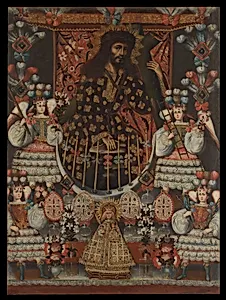
Christ Carrying the Cross, called "The Lord of the Fall"
ca. 1770–75
Medium
Oil and gold on canvas
Dimensions
65 × 48 in. (165.1 × 121.9 cm)
Classification
Painting
Culture
Peru (Cuzco)
Department
The American Wing
Museum
Metropolitan Museum of Art, New York, NY
Credit
Gift of James Kung Wei Li, in memory of Ambassador and Mme Ti-Tsun Li, Republic of China, 2018
Accession Number
2018.652.5
Rights
Public Domain
Tags
Art Historical Context
In the heart of colonial Peru's Cuzco School, this striking painting, *Christ Carrying the Cross, "The Lord of the"*, captures a pivotal moment in Christian iconography around 1770–75. Created by an unknown artist, it depicts Christ bearing his cross, surrounded by angels—a common motif in Andean religious art that blends European Baroque drama with local devotional fervor. The generous use of oil and gold on canvas, measuring an imposing 65 × inches, creates a luminous, otherworldly glow, drawing viewers into the sacred narrative. Gold leaf, a hallmark of Cuzco painting, not only signifies heavenly radiance but also reflects the opulence of viceregal churches where such works adorned altars. Produced in Cuzco during the late colonial era, this artwork embodies the cultural fusion of Spanish Catholicism and indigenous artistry. The Cuzco School flourished in the 17th and 18th centuries, producing vivid images for processions and worship amid Peru's vibrant religious life. "The Lord of the Fall" likely evokes a revered Christ figure tied to local miracles or earthquakes—common in Andean lore—emphasizing themes of suffering, redemption, and divine protection. Today, it graces The American Wing at the Metropolitan Museum of Art, a gift honoring Ambassador and Mme. Ti-Tsun Li, inviting us to ponder faith's enduring power across continents and centuries.
About the Artist
Unknown
The artist designated as "Unknown" in our virtual museum's collection exemplifies a poignant chapter in art history: creators whose identities have faded into obscurity despite the enduring power of their work. With only one known artwork attributed to them in our holdings, this figure represents countless anonymous hands that shaped visual culture across centuries. Museums worldwide, including th...