
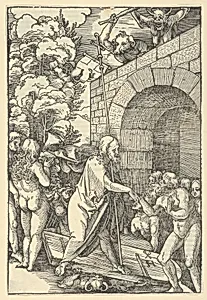
Christ in Limbo, from Speculum passionis domini nostri Ihesu Christi
Medium
Woodcut
Dimensions
Sheet: 9 1/4 × 6 1/4 in. (23.5 × 15.9 cm)
Classification
Prints
Department
Drawings and Prints
Museum
Metropolitan Museum of Art, New York, NY
Credit
Gift of Junius S. Morgan, 1919
Accession Number
19.52.57
Rights
Public Domain
Tags
Art Historical Context
"Christ in Limbo" a striking woodcut from the 7 publication *Speculumis domini nostri Iu Christi* ("Mirror of the Passion of Our Jesus Christ"), a devotional book blending text by Ulrich Pinder with illustrations to Hans Schäufelein and printed by Friedrich Peypus. Northern Renaissance print captures Christ descending into Limbo after his crucifixion—a pivotal moment in Christian theology where he liberates the souls of the righteous from the underworld. Schäufelein, a German artist influenced by Albrecht Dürer, infuses the scene with dramatic intensity, evident in the tags noting suffering, male and female nudes, which underscore the raw humanity and torment of the figures. As a woodcut, the medium was revolutionary for its time, allowing intricate designs to be carved into wood blocks and printed affordably on a large scale. This democratized religious imagery during the late medieval period, just before the Protestant Reformation, fostering personal piety among laypeople who couldn't afford paintings or sculptures. Measuring a compact 9¼ × 6¼ inches, it was ideal for portable prayer books. Today, this print resides in the Metropolitan Museum of Art's Drawings and Prints department, a gift from Junius S. Morgan in 1919. exemplifies early 16th-century German printmaking's power to evoke empathy and faith through bold contrasts and expressive nudity.
About the Artist
Hans Schäufelein|Ulrich Pinder|Friedrich Peypus · 1480–1540
Hans Schäufelein (c. 1480–c. 1540) was a German painter and graphic artist of the Northern Renaissance whose career placed him at the heart of one of the most dynamic artistic environments in European history. As a young man, he entered the workshop of Albrecht Dürer in Nuremberg, an experience that proved decisive: Dürer's meticulous approach to draughtsmanship, his mastery of printmaking, and hi...