
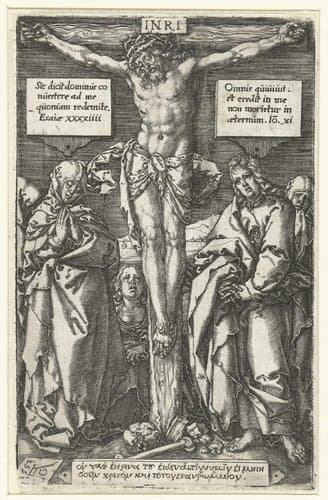
Christus aan het kruis
Medium
engraving
Dimensions
73; 114
Rights
Public Domain
About this artwork
Christus aan het kruis, rechts van hem Maria en een van de drie Maria's, links van hem Johannes met een van de drie Maria's, aan de voet van het kruis Maria Magdalena. Drie cartouches, twee met een vierregelige tekst in het Latijn en één met een tweeregelige tekst in het Grieks, overgenomen van een gravure van Brosamer.
Art Historical Context
Behold *Christus aan het kru* (Christ on the Cross), a poignant 1553 engraving by Aldegrever, a masterful German artist of the Northern Renaissance and one of the "Little Masters" renowned for their intricate small-scale prints. Measuring just 114 mm high by 73 mm wide, this delicate work captures the Crucifixion with profound emotional depth, centering Christ on the cross flanked by key biblical figures: the Virgin Mary and one of the holy women to his right, St. John the Evangelist another Mary to his left, and Mary Magdalene weeping at the foot. Aldegrever's composition draws directly from an earlier engraving by Hans Brosamer, faithfully adapting its layout while adding three elegant cartouches—two with four-line Latin verses and one with two lines in Greek. These inscriptions, evoking scriptural devotion, underscore the print's role as a meditative aid for 16th-century viewers amid the religious upheavals of the Reformation. Engraving, with its fine lines etched into copper plates, allowed for precise detailing and widespread dissemination, making sacred scenes like this accessible for personal prayer in homes across Europe. This artwork exemplifies the era's fusion of artistry and piety, where tiny prints carried monumental spiritual weight, inviting contemplation of Christ's sacrifice in an age of faith and fervor.
About the Artist
Heinrich Aldegrever · 1502–1561
Heinrich Aldegrever, born in 1502 in Paderborn, Westphalia, to parents Herman and Katherine Trippenmeker—a family of clog-makers known by the dialect name Trippenmecker—emerged as a multifaceted artist in the German Renaissance. His early training remains undocumented, though he likely apprenticed in a Soest goldsmith's workshop after relocating there around 1525, where he joined the painters' gui...