
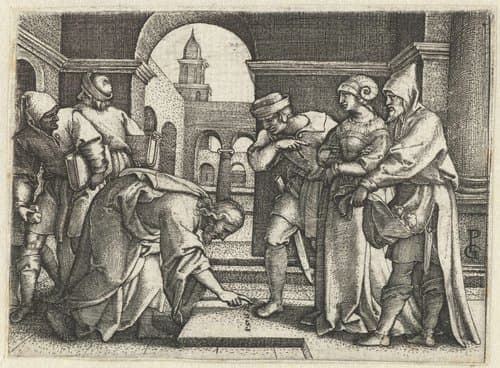
Christus en de overspelige vrouw
1544 - 1548
Medium
engraving
Dimensions
61; 83
Rights
Public Domain
About this artwork
plaatrand: hoogte 61 mm x breedte 83 mm
Art Historical Context
**Christus en de Oversige Vrouw (Christ and the Adulterous Woman *Georg Pencz, 1544–1548, Engraving, 61 × 83 mm* This intimate engraving by German Renaissance artist Georg Pencz a pivotal biblical moment from Gospel of John (81–11), where Jesus forgives an adulterous woman accused by a crowd, challenging them with the words, "Let he who is without sin cast first stone." Created during Pencz's mature years in Nuremberg, a hub of Northern Renaissance art, the work reflects the era's fascination with moral and theological themes amid the Protestant Reformation. Pencz, a protégé of Albrecht Dürer and a leading engraver, infused his prints with precise line work and expressive figures influenced by Italian Mannerism, making complex narratives accessible to a wide audience. Engraving, Pencz's specialty, involved incising fine lines into a copper plate for inking and printing, allowing high-quality reproductions at modest sizes like this pocket-sized plate (roughly 2.4 × 3.3 inches). Such small-scale works were prized by collectors, scholars, and the devout, serving as affordable devotional aids or portfolio gems. Pencz produced numerous biblical series, showcasing his mastery of light, shadow, and emotion through intricate hatching techniques. This piece highlights engraving's role in democratizing art during the 16th century, bridging elite patronage with everyday piety. Visitors, imagine holding this delicate print—its survival speaks to the enduring power of Pencz's storytelling.
About the Artist
Georg Pencz · 1490–1550
Comment on works: Religious; History; Portraits